
Introduction to Binary Options Trading
Binary options trading is a form of financial speculation in which participants attempt to predict the short-term price movement of an asset. The structure is straightforward: a trader forecasts whether the price of an underlying asset will be above or below a specific level at a predetermined time. If the prediction is correct, a fixed return is paid. If the forecast is incorrect, the trader loses the capital committed to the position.
The simplicity of this structure has contributed to the rapid growth of interest in binary options across global markets. Assets typically offered include currencies, commodities, stock indices, and individual equities. Despite its apparent accessibility, binary options trading carries significant risks. These risks stem not only from market volatility but also from structural characteristics of the product, operational challenges, and varying levels of regulatory oversight. A thorough understanding of these elements is essential before engaging in such activity.
How Binary Options Work
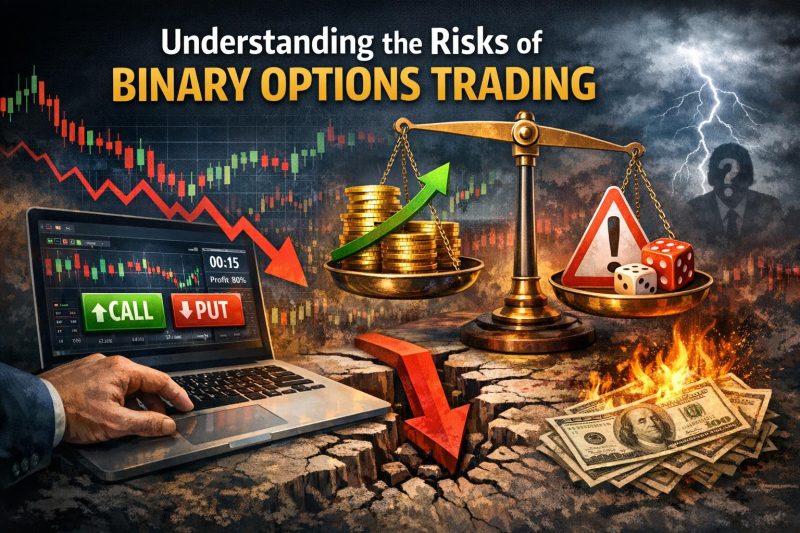
In a standard binary options contract, the trader selects an asset and chooses an expiration time, which can range from a few seconds to several hours or even days. The trader then determines whether the asset’s price will be above or below a predefined strike price at expiration. This decision typically takes the form of a “call” (predicting a rise) or a “put” (predicting a fall).
The payout is predetermined and disclosed at the time the trade is placed. For example, a platform may offer a return of 70–90 percent on a successful trade. This means that if a trader invests a fixed amount and the outcome is favorable, the total return includes the original stake plus the specified profit percentage. If the trade expires out of the money, the entire investment is generally forfeited.
This fixed risk and fixed reward structure distinguishes binary options from traditional trading instruments such as stocks or forex. In conventional trading, gains and losses fluctuate continuously with market prices, and traders can exit positions at any time to limit losses or secure partial profits. In binary options, the result is determined exclusively at expiration, and outcomes are typically all-or-nothing.
Expiration times often play a crucial role in shaping the risk profile of a trade. Very short-term options amplify exposure to minor price fluctuations and market noise. Longer-dated contracts introduce broader economic and geopolitical factors that may influence asset prices. Understanding how time horizon interacts with asset behavior is fundamental to risk management.
Key Risks Associated with Binary Options Trading
Binary options trading involves a combination of market, structural, and operational risks. These risks may not be immediately evident to new participants because of the product’s simplified presentation. However, a closer examination reveals multiple layers of complexity that can affect outcomes.
Lack of Regulation
Regulatory oversight is one of the most significant factors affecting the safety of financial market participation. In many jurisdictions, binary options have historically operated in regulatory gray areas. Some countries treat them as legitimate financial derivatives subject to supervision, while others classify them as gambling products. In certain regions, regulators have restricted or prohibited retail binary options trading due to concerns over investor protection.
A platform operating without meaningful regulatory supervision may present several risks. These include insufficient segregation of client funds, unclear order execution practices, limited transparency in price feeds, and weak dispute resolution mechanisms. Regulatory authorities typically enforce standards related to capital adequacy, reporting requirements, anti-money laundering controls, and client fund protection. Where such oversight is absent, traders may face increased exposure to misconduct.
It is important to distinguish between platforms that operate under recognized financial authorities and those that claim regulatory status without verifiable documentation. Verification through official regulatory registries can clarify a firm’s standing. A lack of regulation does not automatically imply fraudulent activity, but it substantially reduces available recourse in the event of disputes or operational failures.
High Volatility
Financial markets are inherently volatile. Asset prices respond to economic data releases, corporate earnings announcements, geopolitical developments, and shifts in investor sentiment. In binary options trading, particularly in short-duration contracts, even minor fluctuations can determine whether a trade expires in or out of the money.
Short-term volatility presents a specific challenge because price movements over brief intervals are often influenced by random market noise rather than sustained trends. Traders who engage in contracts lasting under five minutes must contend with spreads, execution delays, and microstructure effects that may outweigh broader analytical considerations.
Moreover, volatility tends to increase during scheduled news events, such as central bank announcements or employment reports. Rapid price swings during these periods can lead to unpredictable outcomes. Because the result of a binary option depends entirely on the price at the exact expiration moment, temporary spikes or reversals can negate an otherwise accurate assessment of market direction.
Over time, consistently overcoming volatility requires disciplined strategy development and statistical awareness. However, even sophisticated approaches cannot eliminate uncertainty. Market behavior is probabilistic rather than deterministic, and this reality underpins the risk profile of binary options.
All-or-Nothing Payout Structure
The defining feature of binary options is the all-or-nothing payout mechanism. Unlike traditional investments, where partial gains or losses can be realized, binary options typically result in either a predetermined gain or the forfeiture of the entire stake. This structure has several implications.
First, the risk-to-reward ratio is often asymmetrical. A trader might risk 100 units to earn 80 units. In this case, the break-even win rate must exceed 55 percent to avoid long-term losses. This requirement is frequently underestimated. Traders may assume that a 50 percent success rate is sufficient, but the payout ratio makes this mathematically unsustainable in many scenarios.
Second, the absence of incremental loss management tools reduces flexibility. Stop-loss orders, trailing stops, and partial position scaling—common in other forms of trading—are generally unavailable. Once a binary option is placed, the trader typically cannot modify the position. Although some platforms offer early exit features, these are often limited and subject to pricing adjustments.
Third, the psychological dimension of repeated all-or-nothing outcomes can influence behavior. Attempting to recover losses by increasing stake size introduces the risk of compounding negative results. This dynamic underscores the importance of disciplined capital allocation and predefined trade sizing rules.
Complexity of Market Analysis
Although binary options are marketed as simple, successful participation requires analytical rigor. Price movements are influenced by a combination of technical patterns, macroeconomic variables, and market sentiment. Traders must interpret these signals within the context of the chosen time frame.
Technical analysis tools such as moving averages, oscillators, and support and resistance levels are frequently applied. However, short-term contracts may reduce the reliability of traditional indicators because patterns that hold over longer durations can break down in shorter intervals.
Fundamental analysis, including the assessment of economic indicators and monetary policy decisions, also affects asset valuations. For example, interest rate changes influence currency markets, while inventory data may affect commodity prices. Traders who ignore such factors may misinterpret market conditions.
In practice, developing a repeatable methodology involves data collection, backtesting, and evaluation of statistical performance. Without systematic evaluation, trading decisions may rely on intuition rather than structured analysis. In such cases, outcomes resemble chance more closely than informed speculation.
Potential for Scams
The history of binary options includes documented cases of fraudulent platforms and unethical practices. Some operators have been accused of manipulating price feeds, delaying withdrawals, or misrepresenting potential returns. Others have engaged in aggressive marketing tactics, targeting inexperienced individuals with unrealistic performance claims.
Fraudulent schemes may involve simulated trading environments that do not connect to actual market data. In these cases, pricing can be adjusted internally to disadvantage the participant. Withdrawal restrictions, excessive documentation requirements, or unexplained account suspensions may also signal operational red flags.
Due diligence is therefore essential. This includes reviewing regulatory status, examining terms and conditions, verifying company history, and evaluating customer support responsiveness. Independent confirmation of a platform’s legitimacy reduces exposure to operational misconduct, although it does not eliminate market risk.
Limited Trading Tools
Compared with established brokerage platforms in equities, futures, or foreign exchange markets, binary options platforms often provide fewer analytical resources. Charting software may be basic, historical data may be limited, and advanced order management functions may be absent.
Limited functionality can impair a trader’s ability to conduct comprehensive analysis. For example, insufficient historical data restricts backtesting, while the absence of customizable indicators can constrain technical evaluation. Additionally, price transparency may vary, especially if the platform serves as the counterparty to client trades.
The structural arrangement in which the platform acts as the direct counterparty can create potential conflicts of interest. In such cases, the platform profits when traders lose and pays out when traders win. While this model can operate legitimately under regulation, it underscores the importance of oversight and transparency.
Risk Management Considerations
Effective participation in binary options trading requires careful attention to capital preservation. Risk management begins with determining a maximum allocation of capital specifically designated for speculative activity. Funds required for essential expenditures should not be exposed to high-risk financial instruments.
Position sizing plays a central role. Limiting each trade to a small percentage of available trading capital reduces the probability that a single unfavorable outcome will cause substantial harm. Because of the asymmetric payout profile described earlier, traders must consider the statistical break-even win rate associated with the offered return percentage.
Record keeping is another important component. Maintaining detailed logs of trades, including asset selection, time frame, rationale, and outcome, enables structured evaluation. Reviewing performance over a meaningful sample size can reveal patterns in strategy effectiveness or weaknesses.
It is also prudent to assess the legal and tax implications of engaging in binary options trading within a specific jurisdiction. Regulatory classifications may influence how profits and losses are treated, and noncompliance with local laws can carry penalties.
Comparisons With Other Financial Instruments
Binary options differ significantly from traditional derivatives such as vanilla options. In conventional options markets, traders acquire the right but not the obligation to buy or sell an asset at a given price before expiration. The value of these contracts fluctuates with changes in volatility, time decay, and underlying price movement. Positions can often be closed prior to expiration at prevailing market prices.
In contrast, binary options do not usually provide intermediate mark-to-market valuation in a manner accessible to the trader. The outcome hinges primarily on the closing price relative to the strike at expiration. This structural difference eliminates some strategic flexibility available in other derivatives markets.
Similarly, direct investments in stocks or currencies allow for longer-term positioning and dividend or interest considerations. Binary options focus narrowly on directional prediction over a defined time horizon, separating price movement from broader ownership considerations.
Long-Term Sustainability and Statistical Realities
An objective evaluation of binary options must consider long-term statistical expectations. Because payout percentages frequently provide less than a one-to-one reward relative to risk, maintaining profitability demands a sustained win rate above the break-even threshold. Achieving such consistency in volatile markets is challenging.
Random sequences of wins and losses can produce short-term gains, but sustaining performance over extended periods requires measurable edge. Establishing such an edge entails structured testing and probabilistic reasoning. Even then, external factors such as shifting volatility regimes or changes in platform conditions can alter performance outcomes.
The inherent design of many retail binary options contracts places structural advantage with the platform, especially if payout ratios are calibrated to maintain favorable odds for the operator. Recognizing this structural dimension is part of realistic risk assessment.
Conclusion
Binary options trading is built on a clear and simplified contractual framework in which traders forecast whether an asset’s price will exceed or fall below a specified level at expiration. This apparent simplicity often conceals substantial complexity. Market volatility, asymmetrical payout ratios, limited analytical tools, and varying degrees of regulatory oversight collectively shape the risk environment.
The absence of partial loss control, combined with fixed expiration outcomes, distinguishes binary options from many other financial products. Participation therefore requires careful capital allocation, disciplined evaluation, and thorough verification of platform legitimacy. Prospective traders should assess not only potential returns but also the statistical and operational structures that govern outcomes.
A comprehensive understanding of these elements allows for informed decision-making. Binary options remain a high-risk form of speculation, and engagement should follow detailed analysis and consideration of personal financial circumstances.
This article was last updated on: June 25, 2026