
Bollinger Bands in Binary Options
Bollinger Bands are a widely used technical analysis tool applied across equities, commodities, currencies, and derivatives, including binary options. Developed by John Bollinger in the 1980s, the indicator is designed to measure market volatility and identify relative price levels. The structure of Bollinger Bands is straightforward: a middle band formed by a simple moving average (SMA), typically calculated over 20 periods, and two outer bands positioned a specified number of standard deviations above and below the SMA. The standard deviation component allows the bands to expand and contract in response to changes in market volatility.
In binary options trading, where outcomes depend on whether the price of an asset will be above or below a specific level at expiration, timing and probability assessment are critical. Bollinger Bands help traders evaluate whether price levels are statistically extended relative to recent data. When the price approaches or touches the upper band, the asset may be considered overbought in the short term. When price reaches the lower band, it may be considered oversold. These conditions do not automatically imply reversals, but they provide a structured framework for evaluating potential price reactions within a predefined expiration window.
The statistical logic behind the bands is based on the assumption that price movements follow a distribution pattern in which most activity occurs near the mean. By plotting standard deviations above and below the moving average, the indicator reflects a dynamic range that contains a large proportion of price data. When price moves outside this range, it signals an unusual deviation that may precede either continuation or reversion, depending on broader conditions.
Construction and Interpretation of Bollinger Bands
The middle line of Bollinger Bands is typically a 20-period SMA, though traders may adjust this depending on the timeframe used in binary options trading. Short-term contracts such as one-minute or five-minute options often employ shorter moving averages to increase responsiveness, while longer expiry contracts may use extended periods for smoother signals.
The upper and lower bands are calculated by adding and subtracting a multiple of the standard deviation from the SMA. The most common setting is two standard deviations. Because standard deviation reflects dispersion from the average, higher volatility leads to wider bands, while lower volatility results in narrower bands. This built-in adaptability makes the indicator suitable for varying market environments.
When prices trend strongly, they may “walk the band,” meaning they move close to or along the upper or lower band for sustained periods. In such cases, interpreting every band touch as a reversal signal can lead to incorrect conclusions. Instead, traders must consider broader context, including trend direction and volatility conditions.
The Bollinger Band Squeeze
The squeeze is a key volatility pattern associated with Bollinger Bands. It occurs when the distance between the upper and lower bands narrows significantly, indicating reduced volatility. Low volatility periods are often followed by expansion phases in which price movement increases. For binary options traders, especially those using breakout strategies, the squeeze can signal the potential for an upcoming directional move.
During a squeeze, the market is typically consolidating within a relatively tight range. Because binary options involve fixed expiration times, traders must determine not only the direction of the anticipated breakout but also whether the move is likely to occur before contract expiry. A squeeze alone does not provide directional bias. Additional analysis is required to assess whether the breakout may occur upward or downward.
Volatility expansion after a squeeze can be observed when the bands begin to widen following a period of contraction. Confirming signals from price patterns, volume data, or complementary indicators may improve the probability of correctly anticipating the direction of the move.
Mean Reversion and Trend-Based Applications
Bollinger Bands are used in both mean reversion and trend-following strategies. In a range-bound market, traders may apply a mean reversion approach. When price touches the lower band while overall market structure remains sideways, a binary options trader may anticipate a movement back toward the middle band. Conversely, price contact with the upper band in a range may suggest a potential downward correction.
In trending markets, however, the interpretation changes. Strong trends often produce repeated touches of one band without significant retracement. In bullish trends, price may repeatedly approach the upper band while the middle band acts as dynamic support. In bearish conditions, price may remain near the lower band. In such circumstances, traders may align their binary options positions with the prevailing direction rather than attempting countertrend trades.
RSI: Relative Strength Index
The Relative Strength Index (RSI), developed by J. Welles Wilder Jr., is a momentum oscillator that measures the speed and magnitude of price changes. The RSI fluctuates between 0 and 100 and is commonly set to a 14-period calculation. Values above 70 are typically interpreted as overbought conditions, while values below 30 indicate oversold conditions. These thresholds can be modified depending on market behavior and the aggressiveness of the trading strategy.
In binary options trading, RSI can assist in identifying potential short-term reversals within the timeframe of a contract. If the RSI exceeds 70 while price touches the upper Bollinger Band, this overlapping signal may suggest the possibility of a short-term pullback. Similarly, when RSI drops below 30 and price contacts the lower band, traders may anticipate a corrective upward movement.
However, in strong trends, RSI may remain in overbought or oversold territory for extended periods. In these cases, interpreting RSI strictly as a reversal signal may be misleading. Instead, traders may use RSI level shifts or divergence patterns to refine their analysis.
RSI Divergence
Divergence occurs when price forms a new high or low that is not confirmed by the RSI. For example, if price reaches a higher high while RSI forms a lower high, this bearish divergence can indicate weakening upward momentum. In binary options trading, especially for short expiry contracts, divergence signals may offer early indications of potential reversals.
When divergence appears simultaneously with price touching or exceeding a Bollinger Band, the confluence of signals may provide additional analytical support. Nevertheless, divergence does not guarantee immediate reversal, and timing remains a significant consideration.
MACD: Moving Average Convergence Divergence
The Moving Average Convergence Divergence (MACD) is a trend-following momentum indicator that illustrates the relationship between two exponential moving averages. The standard calculation subtracts the 26-period exponential moving average from the 12-period exponential moving average to produce the MACD line. A nine-period exponential moving average of the MACD line forms the signal line. The histogram represents the difference between these two lines.
In binary options trading, MACD assists in identifying shifts in momentum and potential trend changes. Because binary options contracts often rely on predicting short-term direction within a defined timeframe, MACD signals must be aligned carefully with the chosen expiration period.
MACD Crossovers
MACD crossovers occur when the MACD line crosses above or below the signal line. A bullish crossover, where the MACD line rises above the signal line, may indicate increasing upward momentum. A bearish crossover suggests the opposite. Traders frequently use these crossovers to confirm signals derived from Bollinger Bands or RSI.
For instance, if price touches the lower Bollinger Band and RSI indicates oversold conditions, a subsequent bullish MACD crossover may serve as confirmation for a call option with an appropriate expiration time. Conversely, a bearish crossover near the upper band may support a put option.
MACD Histogram and Momentum Shifts
The MACD histogram provides a visual representation of momentum expansion and contraction. Increasing histogram bars indicate strengthening momentum, while shrinking bars may signal weakening momentum. Monitoring these changes can help traders gauge whether a price movement is gaining strength or approaching exhaustion.
When combined with volatility insights from Bollinger Bands, the MACD histogram may help determine whether a breakout from a squeeze has sufficient momentum to continue during the contract duration.
Combining Indicators for Effective Trading
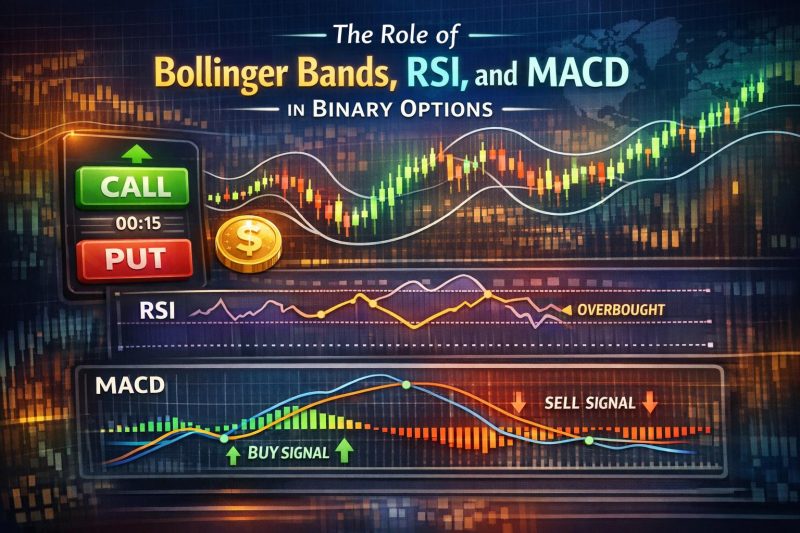
Using Bollinger Bands, RSI, and MACD together can improve analytical depth in binary options trading. Each indicator reflects a different aspect of market behavior. Bollinger Bands focus on volatility and relative price levels. RSI emphasizes momentum extremes. MACD assesses trend and momentum convergence or divergence. By integrating these perspectives, traders may reduce reliance on a single signal.
Consider a scenario in which the market is consolidating, and Bollinger Bands begin to contract into a squeeze. RSI remains near the midpoint, suggesting neutral momentum. A breakout occurs above the upper band, and RSI simultaneously moves above 60 while the MACD histogram expands positively. This alignment may indicate emerging bullish momentum. A trader selecting a call option must still evaluate whether the expected move is likely to persist beyond short-term fluctuations and into the expiration window.
Alternatively, if price reaches the upper Bollinger Band during a sideways market, RSI climbs above 70, and the MACD histogram begins to contract while a bearish crossover forms, these overlapping technical conditions may support a short-term downward expectation.
Timeframe Alignment and Expiry Selection
Binary options require selecting an expiration time in addition to direction. Indicators calculated on shorter timeframes provide more signals but may also produce more noise. Longer timeframes generate fewer signals but may filter out minor fluctuations. Traders often analyze a higher timeframe to determine general trend direction and a lower timeframe to refine entry timing.
For example, if the higher timeframe shows an upward trend with price consistently interacting with the upper Bollinger Band, traders may favor call options on pullbacks identified on the lower timeframe when RSI approaches oversold conditions.
Backtesting and Strategy Evaluation
Systematic evaluation of indicator combinations is essential for assessing their practical effectiveness. Backtesting involves applying a defined set of rules to historical data to measure performance. Traders may record entry criteria such as price touching the lower Bollinger Band, RSI below 30, and bullish MACD crossover, then measure the percentage of contracts that would have expired in the money under specified market conditions.
Backtesting does not eliminate risk, as future conditions may differ from past behavior, but it provides quantitative insights into probability and consistency. Adjustments to indicator settings, such as modifying RSI thresholds or standard deviation multipliers, can be evaluated systematically.
Limitations and Risk Considerations
While Bollinger Bands, RSI, and MACD offer structured analytical frameworks, none of these indicators guarantee predictive accuracy. Market behavior is influenced by numerous variables, including macroeconomic data, geopolitical developments, and liquidity dynamics. Technical indicators are derived from price data and therefore reflect historical movements rather than future certainty.
In binary options trading, incorrect timing can lead to losses even when directional analysis is broadly accurate. Price may eventually move as anticipated but fail to do so within the contract’s expiry period. As such, combining technical insight with disciplined risk management is critical.
Adjusting position size relative to total trading capital, defining consistent entry criteria, and avoiding overtrading are practical considerations that complement technical analysis. Maintaining structured methodology may help reduce variability in outcomes.
Conclusion
Bollinger Bands provide a volatility-based framework for identifying relative price extremes and potential breakout conditions in binary options markets. When integrated with momentum indicators such as RSI and MACD, traders gain a multidimensional view of price behavior. The interaction between volatility contraction and expansion, momentum shifts, and trend confirmation can support more structured decision-making.
Effective application requires adapting indicator settings to the chosen timeframe, aligning trades with prevailing market context, and systematically evaluating performance through historical testing. While no combination of indicators eliminates uncertainty, disciplined integration of Bollinger Bands, RSI, and MACD can contribute to a more methodical binary options trading approach.
This article was last updated on: May 14, 2026