
Introduction to Testing a Binary Options Strategy
Binary options trading involves forecasting whether the price of an asset will be above or below a specified level at a predetermined expiration time. Unlike traditional trading, where profits and losses fluctuate based on how far the market moves, binary options produce a fixed payout if the prediction is correct and a fixed loss if it is incorrect. This simplified payoff structure attracts many traders, but it also requires precise timing and disciplined execution.
Developing a structured approach is therefore critical. A strategy defines the conditions under which a trade is entered, the expiration time selected, and the amount of capital allocated. However, creating a strategy is only the first step. Before committing real funds, traders need a structured process to evaluate whether their method has statistical viability. Testing transforms assumptions into measurable results and provides a framework for continuous improvement.
A well-tested strategy does not eliminate risk, but it provides a clearer understanding of probabilities, potential drawdowns, and realistic performance expectations. Without proper testing, traders may rely on intuition or incomplete observations, which increases exposure to avoidable errors. Thorough evaluation supports informed decision-making and more consistent execution.
Understanding the Importance of Strategy Testing
Testing a binary options strategy serves several interconnected purposes. First, it allows the trader to determine whether the approach demonstrates consistency across multiple market environments. Market conditions vary between trends, consolidations, high volatility phases, and low activity periods. A strategy that performs well in one environment may underperform in another. By testing across different time segments, traders can observe how adaptable the system is.
Second, strategy testing provides quantitative evidence. Trading decisions based solely on isolated examples often lead to misleading conclusions. A strategy might generate several successful trades in sequence, yet still be unprofitable over a larger sample size. Statistical analysis, including win rate and payout ratio, reveals whether the strategy has a positive expectancy over time.
Third, systematic testing helps manage psychological factors. Confidence built on structured data differs from confidence based on optimism. When traders understand the expected range of outcomes, including losing streaks, they are less likely to abandon their plan prematurely. Emotional discipline often improves when expectations are realistic and supported by evidence.
Finally, repeated testing encourages incremental improvements. A trading system is rarely optimal at its initial design stage. Insights from performance data suggest where adjustments may be required, whether in the detection of entry signals, the selection of expiration times, or the application of risk management rules.
Defining a Binary Options Strategy Before Testing
Before testing can begin, the strategy must be clearly defined. Ambiguity reduces the reliability of results. Every rule should be specific and measurable. If a signal is based on technical indicators, such as moving averages or oscillators, the precise settings must be documented. If price action patterns are used, the characteristics of those patterns must be clearly described.
In addition to entry criteria, the strategy should define the type of binary option used, whether high/low, touch/no-touch, or range-based. The expiration time must also be fixed or systematically chosen, as this variable significantly affects performance outcomes. For example, strategies operating on short timeframes react differently to market noise compared to longer-term approaches.
Risk parameters should also be predetermined. Even though binary options have fixed payouts, capital allocation per trade influences overall performance and drawdown levels. Testing must reflect realistic position sizing to produce meaningful insights.
Documenting all parameters ensures that the testing process evaluates a consistent system rather than a flexible interpretation of market behavior.
Steps to Test a Binary Options Strategy
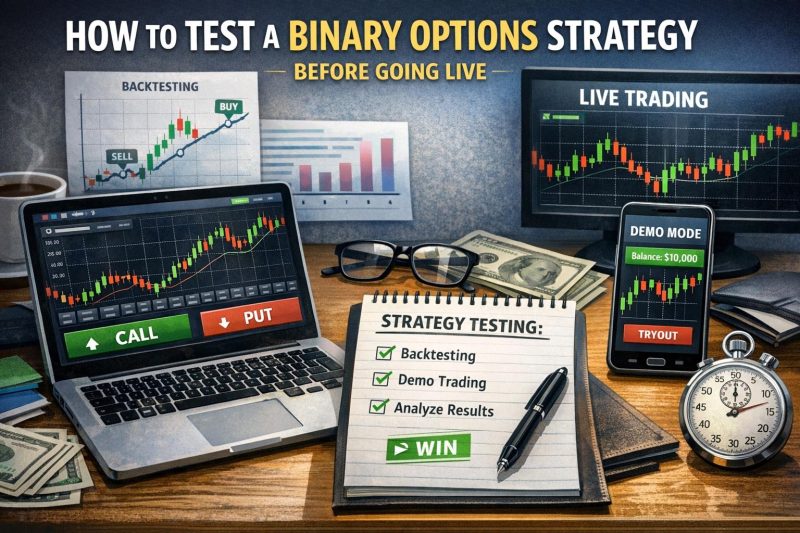
1. Historical Data Analysis
Historical data analysis, often referred to as backtesting, is the first structured step. This process involves applying the predefined trading rules to past market data to evaluate how the strategy would have performed. Backtesting can be conducted manually by reviewing price charts or automatically through software capable of simulating trades based on programmed rules.
The primary objective of historical analysis is to identify patterns of performance across a sufficiently large sample. A small dataset may produce unreliable results. Therefore, traders typically examine multiple months or years of data, depending on the timeframe used in the strategy.
During backtesting, all trades that meet the criteria should be recorded. Selective inclusion of favorable trades distorts results. Each trade entry, expiration time, outcome, and payout should be logged systematically. From this data, performance metrics such as win rate, consecutive losses, and net return can be calculated.
It is also important to test across varied market phases. A dataset that includes trending periods, sideways movements, and volatile sessions provides a broader understanding of potential outcomes. This diversity reduces the risk of designing a strategy that only fits one specific historical scenario.
2. Demo Trading
After completing historical analysis, the next step is forward testing using a demo account. Most established brokers provide simulated trading environments that mirror real-time market conditions. Demo trading bridges the gap between theoretical backtesting and live market execution.
In a demo environment, traders experience real-time price fluctuations, order placement procedures, and trading platform mechanics without risking capital. This stage highlights practical factors that historical testing may not fully capture, such as slight execution delays or pricing variations near expiration.
Forward testing should be conducted over a meaningful period. A limited number of trades may not accurately represent the strategy’s long-term behavior. By maintaining consistent trade execution according to predefined rules, traders gather additional performance data in conditions that more closely resemble actual trading.
Demo trading also provides an opportunity to refine operational aspects, including order timing, chart analysis workflow, and record keeping. A structured trading journal should accompany this phase, documenting each decision and outcome.
3. Analyzing Results
Data collected from historical and demo testing must be analyzed objectively. The primary metric in binary options trading is the relationship between win rate and payout ratio. Because payouts are typically less than 100 percent of the invested amount, a win rate above 50 percent is often necessary to achieve profitability. Determining whether the observed win rate exceeds the break-even threshold is fundamental.
Beyond overall profitability, traders should examine performance consistency. Large fluctuations in results or extended losing streaks may indicate sensitivity to specific market conditions. Assessing the average return per trade, maximum drawdown, and distribution of consecutive losses helps gauge the stability of the approach.
Comparing results between historical backtesting and demo trading can reveal discrepancies. Significant differences may indicate overfitting during historical optimization or structural differences between past and present market dynamics.
The analysis stage should focus on identifying structural strengths and weaknesses rather than isolated anomalies. Patterns recurring across large samples are more meaningful than individual outliers.
4. Strategy Optimization
Optimization involves adjusting selected parameters to improve performance while preserving the core logic of the strategy. This might include modifying indicator settings, refining entry filters, or selecting a more suitable expiration time.
Any change should be tested systematically rather than applied impulsively. A disciplined approach involves altering one variable at a time and retesting the strategy to measure its specific effect. Simultaneous multiple adjustments can obscure the true cause of performance changes.
It is essential to avoid excessive curve-fitting, a process where rules are tailored too closely to historical data. Over-optimized strategies often perform poorly in forward testing because they are designed around past noise rather than consistent market behavior. Maintaining simplicity reduces the risk of overfitting and improves adaptability.
Optimization is best viewed as an iterative process. Gradual improvements based on structured evaluation tend to produce more stable systems compared to radical changes driven by short-term results.
Tools and Resources for Strategy Testing
A range of tools supports effective strategy testing. Many trading platforms include integrated charting features and historical data access. Some platforms allow users to simulate trades directly on past charts, providing visual confirmation of signal accuracy.
Dedicated backtesting software enables automated simulation based on coded trading rules. These tools generate detailed performance reports that calculate statistics such as expectancy, equity curve progression, and drawdown periods. For traders comfortable with programming, algorithmic testing provides speed and precision when evaluating large datasets.
Spreadsheets are also valuable for organizing trade records and computing performance metrics. Even basic spreadsheet functionality can produce meaningful analysis when data is collected consistently.
In addition to technical tools, maintaining a structured trading journal enhances insight. Recording contextual observations, such as prevailing volatility or macroeconomic events, may reveal external influences on outcomes.
Risk Management Considerations During Testing
Effective testing integrates realistic risk management assumptions. Even a strategy with a favorable expectancy can generate significant drawdowns if capital allocation per trade is excessive. During simulation and demo phases, position sizing should reflect the intended live trading approach.
Calculating the potential impact of consecutive losses is particularly important in binary options trading. Since losses are fixed and immediate at expiration, a series of unsuccessful trades can reduce capital rapidly. Understanding the historical distribution of losing streaks enables better preparation for live conditions.
Risk management testing should also consider account growth scenarios. Evaluating how the strategy performs under fixed fractional risk models helps determine whether performance remains stable as capital fluctuates.
Testing without incorporating capital management variables can lead to misleading conclusions about overall viability.
Risks and Challenges
Despite comprehensive testing, binary options trading remains subject to inherent uncertainty. Market conditions evolve due to economic releases, geopolitical developments, and shifts in investor sentiment. A strategy that performed consistently in the past may encounter reduced effectiveness as conditions change.
Short-term trading, common in binary options, can be influenced by price noise and temporary imbalances between supply and demand. Rapid fluctuations may produce unexpected outcomes even when the broader analysis appears correct.
Another challenge involves data quality. Inaccurate historical pricing or inconsistent recorded payouts can distort backtesting results. Ensuring reliable data sources is essential for meaningful conclusions.
Psychological discipline also remains relevant after testing. Even a thoroughly evaluated strategy requires consistent execution. Deviating from predefined rules during live trading undermines the integrity of prior analysis.
Transitioning from Testing to Live Trading
Once historical and demo testing demonstrate consistent results over sufficient sample sizes, traders may consider transitioning to live trading with limited capital. Beginning with smaller trade sizes allows further validation under real financial conditions.
Early live performance should be compared with previous testing data. Minor variations are expected due to real-time execution differences, but substantial deviations may require reassessment. Maintaining the trading journal during this phase ensures continuity of analysis.
A structured review schedule supports ongoing adaptation. Markets are dynamic, and periodic reevaluation of performance metrics ensures that the strategy remains aligned with current conditions.
Conclusion
Testing a binary options strategy is a structured process that combines historical analysis, forward simulation, data evaluation, and measured optimization. Each stage contributes to a clearer understanding of performance probabilities and operational requirements. By defining precise rules, collecting comprehensive data, and interpreting results objectively, traders gain insight into both the potential strengths and limitations of their approach.
Although no strategy eliminates risk, systematic testing establishes realistic expectations and reinforces disciplined execution. Through continuous evaluation and measured adaptation, traders create a structured foundation for decision-making in the binary options market.
This article was last updated on: May 29, 2026