
Understanding Binary Options
Binary options are a category of financial derivatives that provide a fixed payout if a specified condition is met at the time of expiry, or no payout if the condition is not met. The term binary reflects the structure of the contract: there are only two possible outcomes. Either the option expires “in the money,” resulting in a predetermined return, or it expires “out of the money,” resulting in a loss of the invested amount. Unlike traditional options, where profits or losses can vary depending on how far the asset’s price moves, binary options deliver an all-or-nothing result.
In a typical transaction, a trader selects an underlying asset such as a currency pair, stock, commodity, or index. The trader then determines whether the price of that asset will be above or below a specified strike price at expiration. If the trader expects the price to rise above the strike price, they may purchase a call option. If they expect the price to fall below that level, they may purchase a put option. The key variables in a binary options contract include the underlying asset, the strike price, the expiry time, and the fixed payout amount.
Binary options have been widely discussed in financial markets due to their simplicity and accessibility. The structure makes them straightforward to understand in comparison to more complex derivatives. However, this simplicity does not eliminate risk. The probability of price movement within a specific timeframe remains uncertain, and traders must rely on analysis, risk management, and disciplined decision-making.
Core Structural Features of Binary Options
Binary options differ from conventional trading instruments in several significant ways. First, the payout is predetermined at the time of entering the contract. Traders know in advance what the potential return will be if the trade succeeds and how much they stand to lose if it fails. This transparency in risk-reward calculation can assist in capital allocation and strategy planning.
Second, binary options are time-bound. Every contract has an expiration date and time, which can range from minutes to months. The outcome is assessed strictly at that moment. It does not matter if the asset price temporarily exceeded or fell below the strike price during the life of the contract; only the price at expiry determines the result.
Third, binary options generally require a clear directional view. Traders must decide whether the market will be above or below a certain level at a specific future time. This simplified decision contrasts with other trading instruments where partial profits, stop-loss orders, or trailing strategies may produce more variable outcomes.
Short-Term Binary Options
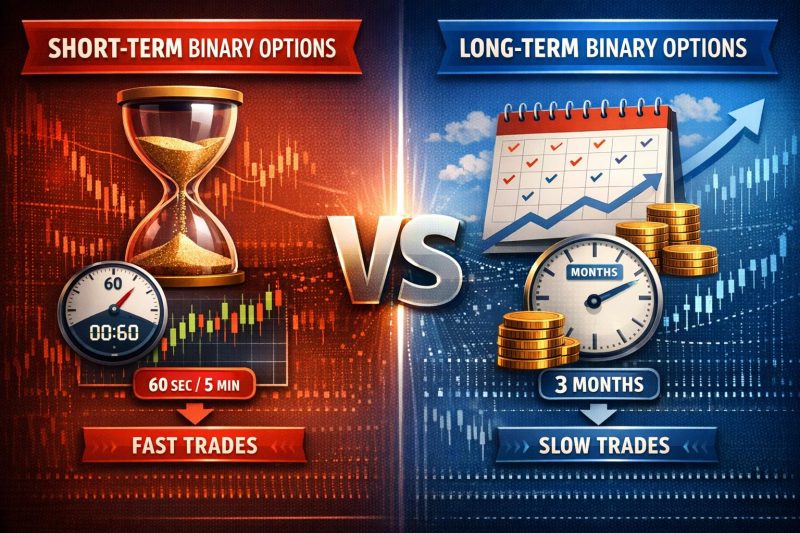
Short-term binary options typically have expiry times ranging from a few minutes to several hours. In some markets, they may even expire within sixty seconds. The defining characteristic of this category is the compressed timeframe in which price movement must occur. Because outcomes are determined quickly, these instruments often attract traders who prefer rapid execution and immediate feedback.
In short-term trading, market conditions can shift abruptly. Price movements within small time intervals may reflect microeconomic factors, sudden news releases, technical trading patterns, or temporary liquidity imbalances. As a result, forecasting price direction over a short timeframe requires focused attention and precise timing.
Characteristics of Short-Term Binary Options
Volatility plays a central role in short-term contracts. Over brief time horizons, asset prices may fluctuate more unpredictably. Minor news events or technical signals can generate noticeable price swings. This volatility can produce opportunities when a trader correctly anticipates movement, but it also increases exposure to unexpected reversals.
Technical analysis is commonly used in short-term trading. Many participants rely on price charts, trend lines, support and resistance levels, and technical indicators such as moving averages or momentum oscillators. Because fundamental developments often exert influence over longer horizons, technical tools may be considered more practical for immediate decision-making.
Benefits of Short-Term Binary Options
One significant advantage of short-term binary options is the ability to realize outcomes quickly. Traders do not need to hold positions overnight or for extended periods. This can reduce exposure to unforeseen macroeconomic news or major market shifts that occur outside trading hours. Rapid settlement of contracts also enables flexible capital deployment, as funds may become available for new trades shortly after expiration.
Short-term options may also align with traders who prefer concentrated trading sessions rather than continuous market monitoring. A trader can focus on specific intervals during high liquidity periods and refrain from participating during quieter sessions. In markets such as foreign exchange, where liquidity peaks during certain overlap hours, short-term contracts may complement intraday strategies.
Another practical consideration is the clarity of risk. Since the payout and potential loss are known in advance, risk can be calculated precisely on each trade. For traders applying strict risk management rules, this structure can assist in maintaining consistency.
Drawbacks of Short-Term Binary Options
Despite their perceived simplicity, short-term binary options carry notable limitations. Rapid expiration requires quick decision-making, which may increase the likelihood of errors. Even well-researched projections can fail if market noise interferes within the brief timeframe.
Transaction costs may also accumulate if trades are executed frequently. Although the cost structure varies depending on the platform or regulatory environment, pursuing a high volume of short-term trades can reduce net profitability over time.
Market randomness is another relevant factor. In very short periods, price fluctuations may reflect temporary imbalances rather than sustained trends. This can make consistent forecasting difficult, even when using structured analytical methods. Consequently, traders may face a higher probability of losing trades if they rely solely on short-term price signals without broader contextual analysis.
Long-Term Binary Options
Long-term binary options have expiry dates that extend from several hours to weeks, months, or occasionally longer. These contracts allow traders to interpret market developments within a broader analytical framework. Instead of focusing solely on immediate fluctuations, participants may consider economic data, corporate earnings reports, policy decisions, or macroeconomic cycles.
The extended timeframe provides more opportunities to evaluate trends and assess whether fundamental shifts are likely to influence price direction. For example, if a central bank announces changes in monetary policy, a trader might evaluate how those changes could affect currency values over the coming weeks.
Characteristics of Long-Term Binary Options
Stability often becomes more apparent over longer horizons. Although short-term volatility remains present, broader trends may help smooth temporary fluctuations. Longer timeframes can reduce the influence of brief market noise and isolated technical patterns.
Fundamental analysis is frequently applied in long-term strategies. Traders may examine financial statements, economic forecasts, interest rate policies, inflation data, or sector-specific developments. By considering structural drivers of price movement, traders attempt to form a more comprehensive outlook that extends beyond immediate chart patterns.
Benefits of Long-Term Binary Options
Long-term binary options provide increased time for research and assessment. Traders can review economic indicators, monitor geopolitical developments, and analyze company performance before entering positions. The additional preparation may contribute to more structured decision-making.
Because the contract does not expire immediately, there may be less pressure to respond to minor hourly fluctuations. A trader’s thesis can unfold gradually, allowing trends or macroeconomic adjustments to support the predicted direction. This may reduce sensitivity to intraday volatility.
Another potential advantage involves strategic diversification. With longer expiry dates, traders may space out their positions across different timeframes, creating a layered approach to risk allocation. This structure can help limit overconcentration in rapid trades.
Drawbacks of Long-Term Binary Options
One limitation of long-term contracts is reduced liquidity during the holding period. Capital committed to a trade typically remains inaccessible until expiry, unless the platform provides an early exit mechanism. This can limit flexibility in adjusting strategies or reallocating funds.
In addition, long-term projections carry uncertainty tied to evolving macroeconomic conditions. New regulations, unexpected geopolitical developments, or shifts in investor sentiment may alter the market environment before the contract expires. Although the longer timeframe allows deeper analysis, it also introduces exposure to extended risk.
The cost structure of long-term binary options may differ from shorter contracts. In certain cases, larger upfront investments are required to secure proportionate payouts. Traders must evaluate whether the potential return justifies the opportunity cost of locking in capital over extended periods.
Comparative Analysis of Short-Term and Long-Term Approaches
When comparing short-term and long-term binary options, several dimensions merit consideration. Time horizon is the most immediate distinction, but underlying strategy, psychological tolerance, and risk exposure also vary substantially.
Short-term strategies emphasize responsiveness and technical precision. The trader operates within compressed windows, seeking to capitalize on immediate opportunities. This approach often demands continuous monitoring and disciplined execution. Long-term strategies, in contrast, emphasize structural evaluation and patience. The trader formulates a thesis about macroeconomic or corporate developments and allows time for those assumptions to materialize.
Market conditions can influence the relative suitability of each approach. In highly volatile environments characterized by rapid news dissemination, short-term contracts may produce frequent signals. However, in stable economic climates with gradual trend development, long-term contracts may align better with prevailing conditions.
It is also relevant to consider transaction frequency. A trader executing numerous short-term contracts each day experiences a different risk pattern compared to a trader holding a small number of longer-term positions. The aggregate probability distribution of outcomes differs because of repeated exposure to binary payoff structures.
Risk Management Considerations
Risk management remains central to trading binary options, regardless of timeframe. Because each contract results in a complete gain or loss of the invested amount, the probability of success and the payout ratio must be carefully evaluated. A trader should consider the break-even win rate required to offset losses and achieve profitability.
Position sizing is particularly important. Allocating a fixed percentage of total capital per trade can reduce the impact of consecutive losses. Even when using sound analysis, losing streaks may occur due to the probabilistic nature of markets.
Diversification across assets and expiry dates may also mitigate risk. For example, rather than concentrating entirely on a single currency pair with multiple short-term trades, a trader might distribute exposure across commodities, indices, and equities with varied time horizons.
Regulatory and Market Structure Factors
Binary options availability and regulation vary significantly by jurisdiction. In some regions, financial authorities have imposed restrictions or bans due to concerns about investor protection and transparency. In regulated environments, exchanges may offer standardized binary contracts with defined specifications. In less regulated settings, contract terms can vary widely between providers.
Understanding the legal framework in a given jurisdiction is essential before participating in binary options trading. Regulatory oversight can influence factors such as payout structures, settlement procedures, and dispute resolution mechanisms. Traders should ensure that the trading venue complies with applicable financial laws.
Strategic Integration with Broader Investment Portfolios
Binary options may function as standalone speculative instruments or as components of a broader portfolio. Some traders use them to hedge specific exposures. For instance, an investor holding a portfolio of equities might use binary options to speculate on short-term directional movements in market indices.
Because the payout is fixed, binary options provide clearly defined exposure. This can complement other instruments that offer variable returns. However, the all-or-nothing payoff limits flexibility in adjusting positions once entered.
Incorporating binary options into a diversified investment strategy requires careful assessment of correlation, risk appetite, and capital allocation. The simplicity of the instrument does not eliminate the necessity for disciplined portfolio management.
Psychological and Behavioral Factors
Behavioral considerations influence both short-term and long-term trading decisions. The binary outcome structure may intensify focus on win rates rather than on long-term expectancy. Traders must remain aware that consistent profitability depends on maintaining a favorable ratio between payouts and probabilities, not merely on achieving frequent wins.
Short-term traders may experience pressure associated with rapid decision cycles. Long-term traders, by contrast, may encounter uncertainty during extended holding periods. In each case, maintaining structured rules and predefined criteria supports more consistent outcomes.
Conclusion
Binary options present a distinct financial instrument characterized by fixed payouts and predetermined expiry times. The binary structure simplifies the mechanics of trading but does not eliminate uncertainty or risk. Short-term binary options emphasize rapid execution and technical analysis, offering quick outcomes but heightened exposure to short-term volatility. Long-term binary options allow for broader analytical frameworks and reduced sensitivity to immediate fluctuations, yet they require extended capital commitment and tolerance for evolving market conditions.
Selecting between short-term and long-term approaches depends on objectives, analytical methods, time availability, regulatory environment, and risk tolerance. A structured evaluation of probability, payout ratio, and capital management remains essential in both cases. By understanding the mechanics, advantages, and limitations of each timeframe, traders can make informed decisions aligned with their broader investment strategies.
This article was last updated on: June 13, 2026