
Understanding Binary Options
Binary options are a type of financial derivative contract in which the outcome is limited to two possible results: a fixed payout or no payout at all. The structure is based on a simple proposition. A trader predicts whether the price of a specific underlying asset will move above or below a predetermined level within a specified period. If the prediction is correct at expiration, the trader receives a predetermined return. If the prediction is incorrect, the trader loses the invested amount.
The underlying assets in binary options trading may include foreign exchange currency pairs, stocks, stock indices, commodities, or cryptocurrencies. Each contract defines key elements in advance, including the strike price, expiration time, and potential payout. Because the payout and loss are fixed, traders know their potential risk and return before entering the position.
Binary options differ from traditional investing or trading in several important respects. In conventional stock or forex trading, profits and losses fluctuate based on how far the asset price moves. In binary options, the magnitude of the movement is irrelevant. The only factor that determines profit is whether the asset price is above or below the strike price at the time of expiration. This all-or-nothing framework explains the term binary, indicating two possible outcomes.
The simplicity of binary options has contributed to their popularity, particularly among inexperienced traders. The format does not require complex position management or detailed knowledge of margin requirements. However, while the mechanics are straightforward, the financial risks are substantial. Short expiration times, high volatility, and fixed-loss structures create a trading environment where capital can be depleted quickly. In addition, the industry has been affected by widespread fraudulent activity, making caution essential.
How Binary Options Trading Works
To understand the risks and opportunities associated with binary options, it is necessary to examine how a typical trade is structured. When entering a trade, the trader selects an asset and chooses an expiration period. Expiration times can range from seconds or minutes to months, depending on the platform.
The trader then decides whether the asset price will rise above or fall below the strike price by expiration. This decision is often labeled as a “call” for an upward prediction or a “put” for a downward prediction. The amount invested is determined in advance, and the percentage return for a successful trade is clearly displayed before confirmation.
For example, if a trader invests $100 in a binary option offering an 80 percent payout, a correct prediction would return $180 in total, representing the original $100 plus $80 profit. An incorrect prediction results in a total loss of the $100 invested. The simplicity of this calculation is appealing, but it also highlights the importance of probability. If the win rate does not exceed the implied break-even threshold, losses will accumulate over time.
Market Structure and Regulatory Differences
Binary options are offered in different regulatory environments across jurisdictions. In some countries, regulated exchanges list standardized binary options contracts. These exchange-traded products are typically overseen by financial authorities and follow strict reporting and transparency requirements.
However, many binary options platforms operate as over-the-counter brokers. In these arrangements, the platform itself may act as the counterparty to the trade. This structure introduces potential conflicts of interest because the broker may profit when the client loses. In regulated environments, compliance standards attempt to address these conflicts, but in unregulated settings the risk of unfair practices increases significantly.
Regulatory approaches vary. Some jurisdictions have restricted or banned the marketing of binary options to retail clients due to widespread abuses. Others permit trading under strict licensing regimes. Understanding the regulatory status of a platform is therefore an essential step before engaging in any transaction.
Identifying Common Scams
The rapid growth of binary options trading attracted not only legitimate firms but also fraudulent operators. Many scams have followed a similar pattern, combining misleading marketing, technological manipulation, and high-pressure sales practices.
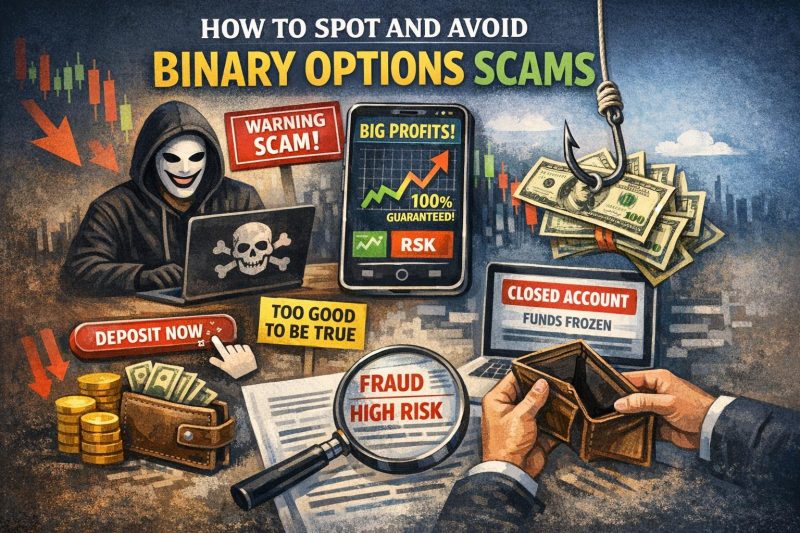
Unrealistic Promises are among the most common warning signs. Fraudulent platforms frequently advertise guaranteed profits, consistently high returns, or proprietary systems that eliminate risk. In legitimate financial markets, returns are never guaranteed. Price movements are influenced by economic data, geopolitical developments, and market sentiment, all of which introduce uncertainty. Any assertion of risk-free trading should be regarded with skepticism.
Lack of Regulation is another significant red flag. Fraudulent platforms may falsely claim to hold licenses or display fabricated registration numbers. Some provide incomplete corporate information or operate from jurisdictions known for minimal oversight. A legitimate financial service provider should clearly state its regulatory authority and provide verifiable credentials.
Pressure Tactics are also common in scam operations. Sales representatives may contact prospective clients by telephone, email, or social media, urging them to deposit funds immediately to take advantage of a limited-time opportunity. In some cases, individuals are promised managed accounts with guaranteed daily profits. These tactics are designed to accelerate decision-making and discourage careful review. Legitimate financial institutions provide documentation, allow time for consideration, and do not rely on persistent pressure.
Fraudulent schemes may also rely on fabricated success stories. Testimonials featuring exaggerated profits, luxury lifestyles, or rapid wealth accumulation are often staged. Images and identities may be misappropriated to provide a false impression of credibility. Careful verification of such claims is essential.
Recognizing Fake Trading Platforms
A fraudulent binary options operation often relies on a simulated trading interface rather than access to genuine market data. These platforms may display price movements that loosely resemble real markets but are internally controlled. This allows operators to manipulate outcomes in ways that disadvantage traders.
Poorly Designed Websites can signal a lack of professionalism, though appearance alone is not definitive. Errors in spelling, inconsistent branding, and vague descriptions of services may indicate insufficient oversight. Secure platforms should employ encryption protocols and provide transparent documentation about trading conditions.
Withdrawal Issues are one of the most frequently reported problems in binary options scams. Traders may initially experience successful small withdrawals to build confidence. However, when larger amounts are requested, delays arise. Platforms may impose unexpected fees, demand additional deposits to verify accounts, or claim that bonus conditions have not been satisfied. In extreme cases, communication ceases altogether once substantial funds are deposited.
Another warning sign involves the misuse of bonus schemes. Fraudulent platforms sometimes offer attractive deposit bonuses that appear to increase trading capital. However, these bonuses may be tied to restrictive turnover requirements. Until a high volume of trading activity is completed, withdrawals may be blocked. Since the trading conditions are often unfavorable, meeting these requirements can be unrealistic.
Data Manipulation and Trade Interference
Some fraudulent operators manipulate trading results directly. This can occur through artificial adjustment of expiration prices, delays in order execution, or cancellation of profitable trades under vague terms and conditions. Traders may find that successful positions are voided for technical reasons, while losing trades are processed immediately.
In unregulated environments, there may be limited recourse for affected individuals. Without independent oversight, disputes are difficult to resolve. This highlights the importance of verifying that a platform is subject to regulatory supervision and independent auditing.
The Risk Structure of Binary Options
Even in regulated settings, binary options carry inherent risks. The fixed-loss structure means that incorrect predictions result in a total loss of the invested amount. While potential gains are also fixed, the payout percentage is typically less than 100 percent. As a result, the mathematical structure often favors the platform unless the trader maintains a sufficiently high win rate.
Short-term contracts are particularly risky. Price fluctuations over very short horizons are often influenced by random volatility rather than predictable trends. Traders relying solely on intuition or minimal analysis may experience inconsistent results.
In addition, some platforms offer complex variations such as ladder options or boundary options. These instruments introduce additional conditions that can further complicate probability calculations. Traders who do not fully understand contract specifications may misjudge potential outcomes.
Avoiding Binary Options Scams
Reducing exposure to fraud requires systematic evaluation of any trading platform before depositing funds. Careful preparation and independent verification are critical components of due diligence.
Conduct Thorough Research by examining the company’s registration details, physical address, and regulatory affiliation. Regulatory bodies typically maintain searchable databases where licensed entities can be verified. Reviewing enforcement actions or warnings published by authorities can also provide valuable information.
Public reviews and discussion forums may offer insight into user experiences, though such sources should be assessed critically. Both positive and negative reviews can be manipulated. A consistent pattern of withdrawal complaints should not be ignored.
Test Platforms cautiously before committing substantial funds. Many regulated brokers provide demonstration accounts that simulate trading conditions without financial risk. While demo performance does not guarantee live results, it allows potential users to evaluate the trading interface, order execution process, and available tools.
If a live account is opened, starting with a modest deposit can limit potential losses during the evaluation stage. Withdrawal procedures should be tested early to confirm that funds can be accessed without unnecessary barriers.
Use Trusted Platforms that operate under recognized regulatory frameworks. Transparency regarding fees, risks, and dispute resolution procedures is essential. Regulatory oversight generally requires segregation of client funds from company operating accounts, reducing the risk of misappropriation.
The Role of Financial Education
A broader understanding of financial markets can reduce vulnerability to scams and unrealistic expectations. Binary options trading is sometimes marketed as an easy path to rapid returns. In reality, price forecasting requires analysis of market trends, economic indicators, and risk management principles.
Developing knowledge in areas such as technical analysis, fundamental analysis, and probability theory provides a more realistic framework for evaluating opportunities. Even with such preparation, outcomes remain uncertain. Trading should therefore be approached with disciplined risk control and capital allocation strategies.
Traders should also understand the concept of expected value. If a binary option offers an 80 percent payout, the break-even win rate exceeds 55 percent when accounting for total loss on unsuccessful trades. Without maintaining a consistent success rate above this threshold, long-term profitability is unlikely.
Psychological and Behavioral Considerations
Binary options trading can be influenced by behavioral biases. The rapid pace of short-term contracts may encourage impulsive decisions. Confirmation bias can lead traders to favor information that supports their initial view, while ignoring contradictory evidence.
Loss aversion may prompt attempts to recover previous losses through increasingly risky trades. This pattern, sometimes referred to as escalation of commitment, can accelerate capital depletion. Establishing predefined limits on trade size and daily exposure can help mitigate these tendencies.
Fraudulent operators sometimes exploit these behavioral dynamics. By presenting early small wins, platforms may build confidence before encouraging larger deposits. Traders who are aware of these tactics are better positioned to make independent decisions.
Legal Recourse and Reporting Fraud
Individuals who suspect fraudulent activity should document communications, transaction records, and account statements. Reporting concerns to national financial regulators or consumer protection agencies may assist in broader enforcement efforts. While recovering funds from offshore entities can be challenging, early reporting increases the likelihood of coordinated action.
In some jurisdictions, banks or payment service providers may be able to assist with chargeback procedures if fraudulent activity is identified promptly. Time is often a critical factor in such cases.
Relevant Resources
Learn more about how to trade safely and identify trustworthy services by visiting resources provided by reputable financial regulatory bodies such as the Commodity Futures Trading Commission or seeking guidance from investor alerts issued by the U.S. Securities and Exchange Commission at official SEC publications. These organizations publish updates on enforcement actions, common fraud tactics, and best practices for protecting personal finances.
Understanding binary options requires more than familiarity with the mechanics of placing a trade. It involves careful assessment of probability, regulatory status, platform credibility, and personal risk tolerance. While the structure of these contracts appears straightforward, the surrounding environment can be complex. Exercising caution, conducting independent verification, and approaching trading decisions with analytical discipline are essential steps in reducing exposure to financial harm.
This article was last updated on: June 29, 2026