
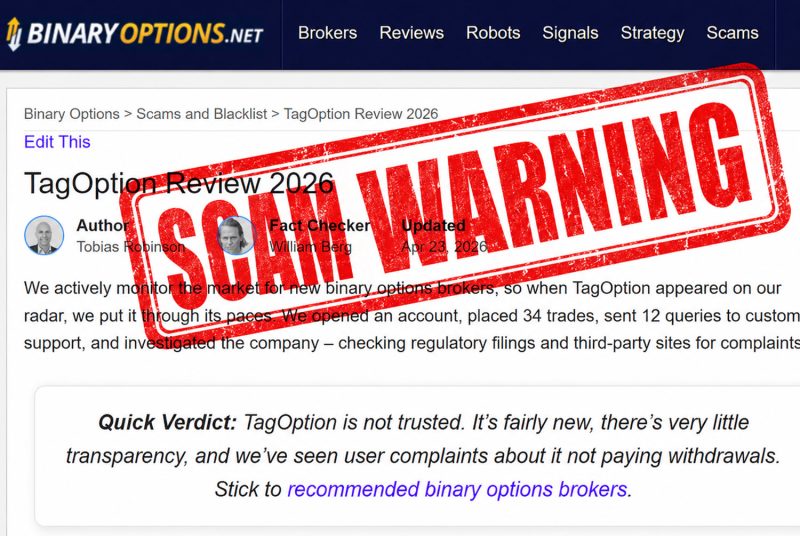
BinaryOptions.net has issued a warning against TagOption after reviewing the broker and concluding that it should not be trusted. The full warning is available in the site’s TagOption review and warning page, while its wider binary options broker reviews and education resources can be found through the BinaryOptions.net navigation page.
According to BinaryOptions.net, its review team opened an account with TagOption, placed 34 trades, sent 12 support queries, checked regulatory filings, and searched third party sites for complaints. The verdict was direct: “TagOption is not trusted.” The review says the broker is fairly new, offers very little transparency, and has attracted user complaints about unpaid withdrawals.
The attached review text supplied for this article gives the same core findings. It says TagOption launched on January 3, 2026, has a $5 minimum deposit, offers trades from $0.10, accepts M Pesa, debit and credit cards, and USDT on TRC20, and advertises payouts up to 95%. It also says the platform listed only 11 volatility binaries despite claiming to offer more than 100 assets.
BinaryOptions.net says TagOption is not a legitimate broker and may be operating a scam. That wording is serious, and the review supports it with several practical concerns: no disclosed legal entity, no physical office address, no licence number, no registered office, no telephone support number, vague support responses, and no regulator details that could be independently verified.
For traders, the warning is not just about one new broker. It is a reminder that a working website and a simple trade ticket do not make a platform safe. A broker can accept deposits, show a dashboard, offer short term contracts, and still fail the basic checks that matter when real money is involved.
What the review found
The first issue raised by BinaryOptions.net is transparency. The review says it searched the TagOption website and client area but found no details about where the broker is based or who operates it. There was no company name beyond the TagOption brand and no physical office address. When the review team asked live chat for this information, support gave vague answers and did not provide the requested details.
That is not a small omission. Traders need to know the legal entity behind a platform before sending money. A brand name is not enough. If a dispute arises, the user needs to know which company holds the funds, which jurisdiction applies, and which regulator, if any, has authority. Without that, the trader is relying mostly on hope. Hope is a poor compliance department.
The second issue is regulation. BinaryOptions.net says it could not find TagOption on any regulatory database and therefore had to assume the broker is unregulated. The review says checks included major financial regulators and offshore jurisdictions sometimes used by binary brokers, including Saint Vincent and the Grenadines, the Seychelles, and Belize. Support staff also did not provide regulatory details when asked.
The third issue is marketing. BinaryOptions.net says TagOption claimed during sign up to have “1M+ traders.” The review questioned that figure because the website was only registered in January 2026 and Trustpilot showed just two reviews, both described as scam complaints. The review does not prove the user number is false, but it says the claim is very unlikely given the limited public footprint.
The fourth issue is platform quality. BinaryOptions.net says it spent hours using the TagOption.com platform and found that many charting features did not work. In particular, attempts to change chart type or add technical indicators did nothing, even after refreshing pages, using different browsers, and retesting on different days. For active traders, this matters. Binary options are already short term and unforgiving. Trading them on a platform where basic analysis tools do not function properly is not exactly ideal. It is like bringing a calculator to an exam and discovering it only does vibes.
The fifth issue is the asset list. BinaryOptions.net says TagOption advertised more than 100 assets during sign up, but each login showed only 11 volatility based binary products. The review suggested these may be broker built assets designed to mimic market like volatility without tracking an underlying financial market. BinaryOptions.net warned that this could make them vulnerable to possible broker manipulation.
The final issue is withdrawals. BinaryOptions.net says it saw user complaints about withdrawal freezes and unpaid withdrawals. Withdrawal complaints are among the most important warning signs in online trading because deposits are usually easy by design. The real test is whether the platform returns funds under clear terms when the client asks.
Why this matters for binary options traders
Binary options are simple in structure but high risk in practice. A trader usually predicts whether a market or instrument will meet a condition by expiry. If the prediction is right, the payout is fixed. If it is wrong, the stake is lost. BinaryOptions.net’s own index explains that binary outcomes are yes or no, with the risk and reward known in advance, and that some contracts can have expiry times as short as five seconds.
That structure attracts traders because it is easy to understand. It also attracts weak operators because the product can be packaged as fast, simple, and beginner friendly. The problem is that simple execution does not mean low risk. Short expiries, fixed payouts, and broker controlled pricing can create a setting where the trader is exposed not only to market risk, but also to platform risk.
BinaryOptions.net’s index warns that binary options scams have been a major problem and that fraudulent and unlicensed operators have exploited binary traders. It also tells readers not to trade with brokers or services on its blacklist and to stick with providers it recommends.
The TagOption warning fits that wider concern. BinaryOptions.net says the broker lacks transparency, appears unregulated, offers a limited set of volatility binaries despite larger asset claims, and operates a platform with glitches that make it inadequate for active trading. Those are not cosmetic flaws. They go to the basic question every trader should ask before depositing: can this firm be trusted with my money?
How traders can stay safe before depositing
The first safety step is to identify the legal entity behind the platform. A trader should know the company name, registration number, registered office, regulator, licence status, and complaint route before funding an account. If the website does not provide those details clearly, or support refuses to answer direct questions, the safest response is to stop.
The second step is to check regulation through official sources, not through badges or claims on the broker’s own website. A platform may show regulator logos, vague statements about compliance, or copied licence language. That is not verification. Traders should go directly to the regulator database and check whether the exact legal entity is authorised for the exact activity being offered.
The third step is matching. The legal entity, website domain, email address, payment recipient, and support contact details should all make sense together. If the broker brand says one thing but the payment beneficiary says another, that is a serious warning sign. Clone firms and unsafe operators often rely on partial checks. They want the trader to find something that looks close enough and move on. Close enough is how money gets lost.
The fourth step is to read the trading and withdrawal terms before depositing. Large withdrawal fees, broad rights to freeze accounts, vague bonus terms, hidden turnover requirements, and foreign dispute clauses can all make recovery difficult. Many traders read payout rates and asset lists while ignoring the terms that control the exit. That is backwards. The exit is where many scams reveal themselves.
The fifth step is to start small and test withdrawals early. A small deposit alone proves very little because even unsafe platforms are usually good at taking money. A small withdrawal test gives more information, though it still does not prove a platform is safe. Some bad operators allow early withdrawals to build trust before blocking larger requests. Still, testing the exit before increasing exposure is basic risk control.
Traders should also keep records from the start. Save account screenshots, deposit confirmations, trade history, chat logs, emails, terms and conditions, withdrawal requests, and any marketing claims shown during sign up. Evidence collected calmly is far better than evidence collected later while trying to reconstruct what happened after the website changes.
What to do if withdrawals are blocked
If a platform delays or blocks withdrawals, traders should stop sending money immediately. Do not pay extra taxes, release fees, wallet unlocking charges, compliance deposits, or account activation payments unless the demand can be independently verified through an official and trusted source. These extra payments are common in trading scams.
Evidence should be preserved before further contact with the platform. Keep screenshots, emails, chat logs, payment receipts, wallet addresses, transaction hashes, account statements, and withdrawal requests. Then contact the bank, card provider, wallet provider, or exchange used to fund the account and ask what dispute, recall, fraud, or chargeback options may be available.
Traders should also report suspected scams to the relevant regulator or consumer protection body in their jurisdiction. Finally, be careful of recovery firms that appear after a loss and promise to retrieve funds for an upfront fee. In many cases, that is just the second scam arriving with better manners and a fresh invoice.
This article was last updated on: May 20, 2026