
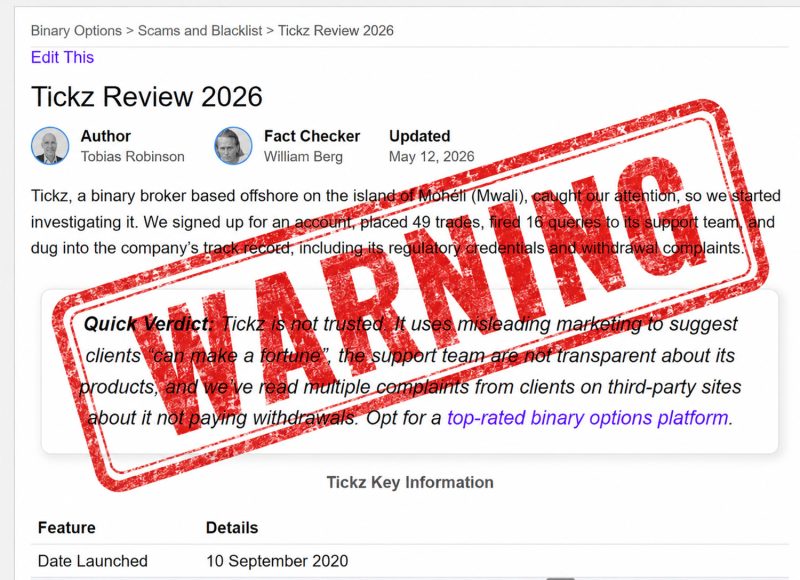
BinaryOptions.net has issued a warning against Tickz after testing the binary options broker and concluding that it should not be trusted. The review says its team opened an account, placed 49 trades, sent 16 support queries, and checked the company’s regulatory position, product claims, user complaints, and withdrawal terms before reaching that verdict. The site’s wider binary options education and broker review index can be found at BinaryOptions.net.
The warning is blunt. BinaryOptions.net says Tickz uses misleading marketing, is not transparent about the products it offers, and has attracted multiple third party complaints about withdrawals being delayed or not paid. The review also says Tickz is operated by Trusteo Ltd, registered with the Mwali International Services Authority in the Comoros Union, but argues that this offshore status does not give retail clients the kind of protections they might expect from stronger regulatory regimes. The same points appear in the attached review text supplied for this article.
BinaryOptions.net’s warning matters because Tickz is not presented as an obvious back alley operation. It has a working platform, low minimum deposits, a range of stated markets, crypto and card payment options, and a web based interface that looks accessible to beginners. That is exactly why the review focuses less on cosmetics and more on harder issues: authorisation, terms, transparency, support quality, withdrawal complaints, and whether the platform accurately describes its own products. In trading, the paint job is rarely where the risk hides.
What BinaryOptions.net found during testing
The review says Tickz markets itself in language that could encourage unrealistic expectations among retail traders. BinaryOptions.net highlighted statements suggesting users could “make a fortune” and that trading can be “surprisingly simple.” That is a serious concern in binary options because the product is simple to understand but not simple to trade profitably. A binary contract usually gives the trader an all or nothing outcome. If the prediction is right, the trader receives a fixed payout. If it is wrong, the stake is lost. That simplicity can make risk feel smaller than it is.
The regulatory finding is also central to the warning. BinaryOptions.net says Tickz is operated by Trusteo Ltd and is registered with MISA under licence number T2022073, but it also says the MISA record showed an active status while listing a licence end date of February 17, 2025. More importantly, the review says MISA does not require segregated client accounts, does not provide investor compensation protection, and does not offer strong dispute routes for clients facing withdrawal problems. That is the point traders should sit with for a moment. A licence name is not the same as meaningful protection.
BinaryOptions.net also says Tickz refused to acknowledge that it offers binary options, despite the structure of its products appearing binary style in testing. The review describes trades where users choose a market direction using buy or sell buttons, select a timeframe from five seconds to five hours, stake from $1, and receive a fixed percentage payout if correct or lose the stake if wrong. According to the review, support staff twice responded with statements along the lines of “we are not a binary platform.” That evasiveness is not a small wording issue. If a provider will not clearly describe the product it sells, the customer is already working with fog.
Withdrawal risk is where the warning gets sharper. BinaryOptions.net says it found 14 Google Play complaints involving delayed or unpaid withdrawals. It also notes that Trustpilot had placed a warning on Tickz, with new reviews blocked after Trustpilot detected suspicious features about the company. BinaryOptions.net said it could not prove the reason, but suspected the platform may have been trying to drown out withdrawal complaints with fake five star reviews. That last point is framed as suspicion, not fact, and should be treated that way. The verified concern is simpler: multiple users complained about getting money out.
The review also flags terms it considers heavily weighted toward the company. The most striking is a clause allowing up to a 20% withdrawal commission. BinaryOptions.net also highlights language capping disputes to deposits only, allowing funds to be held for 180 days over paperwork, and placing disputes under the laws of the Union of the Comoros. For a small retail trader, that is not just legal fine print. It can be the practical difference between having a real route to challenge a problem and having a very expensive lesson in geography.
Why binary options platforms need extra scrutiny
Binary options have a long record of attracting weak operators and outright fraud. The CFTC warns that many binary options websites, social media posts, ads, and online videos promote unregistered platforms, often operated offshore, and that many of these platforms are tied to fraud. The CFTC also says off exchange binary options complaints include firms refusing to return funds, demanding hidden fees, overstating returns, and manipulating charts to make trading appear more promising than it is.
Investor.gov gives similar warnings. It says complaints about internet based binary options platforms include refusal to credit accounts, refusal to return deposits, ignored withdrawal requests, identity theft concerns, and software manipulation that distorts prices and payouts. These are not abstract risks. They map closely onto the areas traders should examine when reading any broker review: who controls pricing, who holds the money, what happens during withdrawal, and which regulator has real authority if something breaks.
The FCA has also warned that binary options scam firms may use professional looking websites, claim a UK presence, manipulate software to fake prices and payouts, then close accounts or refuse to return money. That does not mean every binary options provider is fraudulent. It does mean the sector has enough history behind it that trust should be earned slowly, not handed over because an app has clean buttons and a dark mode.
How traders can stay safe before depositing
The first safety step is to verify the legal entity, not the brand. A brand name can be bought, copied, or abandoned. A legal entity creates the record you can actually check. Before funding any trading account, traders should identify the operating company, its registration number, its regulator, its registered office, and the exact website domain tied to that registration. If the site cannot make those details clear, the safest response is to stop.
The second step is matching. Finding a company with a similar name on a regulator database is not enough. The domain, email address, payment beneficiary, office address, and permission type should all line up. Clone firms often rely on traders doing half a check. They copy a real licence number or use a similar name, then route deposits through a different company or domain. That is where the trap usually sits.
The third step is to read the withdrawal terms before depositing, not after a profitable run. Any clause that allows large withdrawal charges, broad discretion to freeze funds, long holding periods, or disputes capped at deposits only should be treated as a serious risk factor. It may not prove fraud, but it can make recovery difficult when the customer and platform disagree. In Tickz’s case, BinaryOptions.net’s concern about a possible 20% withdrawal charge is exactly the sort of term that traders should look for before they hand over money.
The fourth step is to start small and test the exit. A small deposit proves almost nothing. A small withdrawal test proves a little more, though even that is not conclusive because some bad platforms allow early withdrawals to build trust. Still, testing the withdrawal process early is better than learning the rules after the account balance has grown. Boring, yes. Useful, also yes.
The fifth step is to avoid trading decisions driven by platform nudges. BinaryOptions.net criticised Tickz for gamified platform features such as moving icons encouraging deposits, trading battles, and social trading style prompts. These design choices can push inexperienced traders toward more frequent trading. A careful trader should set stake sizes, session limits, and product rules before logging in, not while a glowing trophy is begging for attention like a bored cat with a finance degree.
What to do if a platform blocks withdrawals
If a platform delays or blocks withdrawals, traders should stop sending further funds immediately. Do not pay extra release fees, tax deposits, insurance charges, or compliance top ups without independent verification. Those demands are common in trading scams and often turn one loss into two.
Preserve evidence before confronting the platform further. Save account screenshots, trade history, withdrawal requests, chat logs, emails, payment receipts, wallet addresses, terms and conditions, and any marketing claims used during sign up. Then contact the payment provider quickly. Banks and card providers may have fraud or dispute routes, though recovery depends on method, timing, jurisdiction, and evidence.
Traders should also report concerns to the relevant regulator or consumer protection body. In the US, binary options concerns may involve the CFTC, SEC, FINRA, or state regulators depending on the product and conduct. In the UK, traders can check the FCA warning resources and report suspected scams. Finally, avoid recovery agents who appear after the loss and promise to retrieve funds for an upfront fee. That is often just the second scam, wearing a cheaper suit.
This article was last updated on: May 20, 2026