
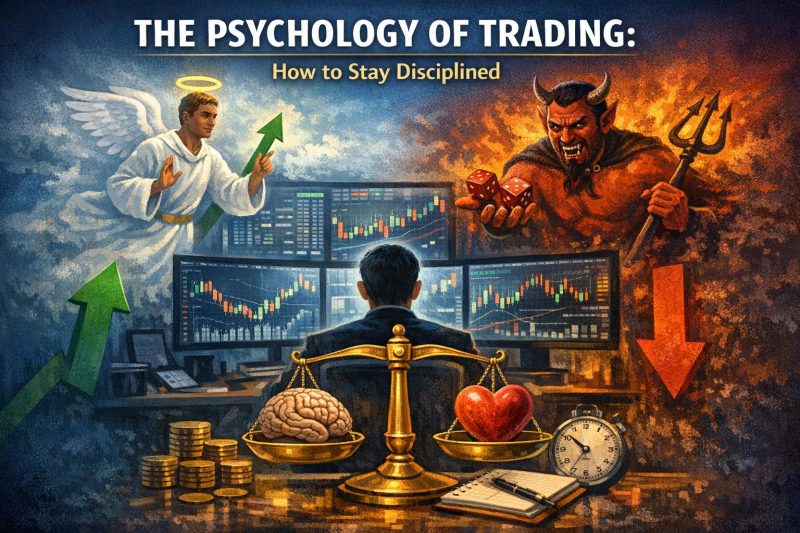
The Role of Psychology in Trading
Trading financial markets effectively requires more than technical knowledge or access to information. While analytical tools, data interpretation, and structured strategies are essential, they are only part of the equation. The psychological dimension of trading often determines whether a participant can apply knowledge consistently and rationally. Markets are environments characterized by uncertainty, rapid change, and financial consequence. Under such conditions, human cognition and emotion play a central role in shaping behavior.
The interaction between market volatility and internal psychological states can either reinforce discipline or undermine it. Even a well-developed strategy can fail if a trader deviates from defined rules due to stress, impatience, or unrealistic expectations. For this reason, understanding psychology in trading is not supplementary; it is foundational. Psychological resilience supports consistency, structured thinking supports rational responses, and discipline ensures adherence to predefined risk parameters.
In professional trading environments, psychological training is often treated with the same importance as technical skill development. Individual traders operating independently face the same pressures, yet they may lack institutional support systems. Recognizing internal patterns, cognitive distortions, and stress responses becomes essential for sustainable performance.
Understanding Emotional Influences
Emotions influence perception, decision-making speed, and risk assessment. In trading, these influences may appear subtle, but their cumulative effect can materially alter results. Emotional awareness does not require eliminating feelings entirely; rather, it requires recognizing how they influence judgments and behaviors.
Fear and Greed: Among the most frequently observed emotional drivers in trading are fear and greed. Fear typically arises when uncertainty increases or when unrealized losses begin to accumulate. It may prompt traders to close positions prematurely, avoid valid setups, or tighten stops beyond strategic necessity. Such actions can result in missed opportunities or distorted risk-to-reward profiles.
Greed, by contrast, often surfaces during periods of profitability. After consecutive successful trades, a trader may increase position size without proportional adjustment in risk controls. Greed can also manifest as reluctance to exit profitable positions at predefined targets, hoping for additional gains without objective justification. In both cases, decision-making shifts away from structured criteria toward emotionally influenced impulses.
Overconfidence: A series of successful trades may foster overconfidence. This psychological state can reduce vigilance and encourage deviation from tested methods. Overconfidence often leads to underestimation of risk and overexposure to market fluctuations. Traders may selectively interpret information to confirm their judgment while disregarding contradictory data. This cognitive bias reinforces inaccurate self-assessment and can magnify eventual drawdowns.
Beyond these prominent emotions, other psychological patterns also shape trading outcomes. Anxiety may impair concentration, particularly in volatile markets. Impatience can lead to entering trades without sufficient confirmation. Frustration after losses can prompt reactive behavior commonly referred to as revenge trading, where the objective shifts from strategy execution to emotional compensation.
Cognitive biases amplify emotional influences. Confirmation bias encourages traders to favor data that supports their positions. Loss aversion causes individuals to experience the impact of losses more strongly than equivalent gains, often motivating the holding of losing positions longer than rational analysis would justify. Recency bias may cause traders to overemphasize recent market events when forming expectations.
Understanding these influences allows traders to distinguish between signals generated by the market and impulses originating from internal responses.
Maintaining Discipline
Discipline in trading refers to the consistent application of a structured methodology regardless of external noise or internal fluctuation. It is the mechanism that bridges planning and execution. Without discipline, even well-designed systems are inconsistently implemented.
Develop a Trading Plan: A clearly defined trading plan establishes objective criteria for participation in the market. Such a plan typically specifies entry conditions, exit targets, stop-loss levels, risk allocation per trade, and overall portfolio exposure limits. It may also define market conditions under which trading should be paused, such as high-impact events or periods of unusual volatility.
A trading plan reduces cognitive load during active sessions. When criteria are predefined, decisions depend less on spontaneous interpretation. This structure limits room for emotionally driven improvisation. However, merely drafting a plan is insufficient; consistent adherence determines its value. Traders often benefit from documenting trades and evaluating whether actions align with planned rules.
Set Realistic Goals: Expectations strongly influence psychological stability. Unrealistic performance goals may generate unnecessary pressure, particularly during inevitable periods of drawdown. Markets do not provide linear returns, and variability is inherent in trading outcomes. A focus on process-oriented objectives, such as adherence to risk parameters or consistent execution, fosters long-term sustainability.
Realistic goal setting also involves capital preservation priorities. Rather than measuring progress exclusively through profit targets, disciplined traders emphasize controlled risk exposure. By defining acceptable loss thresholds and tolerable drawdowns, they create boundaries that protect capital and psychological equilibrium.
Routine contributes to discipline. Many effective traders establish structured pre-market and post-market procedures. Before trading sessions, they may review economic calendars, market trends, and personal readiness. After each session, they may analyze trade execution relative to plan criteria. Regular evaluation transforms trading into a systematic professional activity rather than a reactive pursuit.
Strategies for Emotional Control
Psychological control does not imply suppressing emotion entirely. Instead, it involves recognizing internal states and preventing them from dictating behavior. Several practical approaches enhance emotional regulation.
Mindfulness and Self-awareness: Mindfulness refers to the deliberate observation of thoughts and feelings without immediate reaction. In trading contexts, this awareness helps identify when decisions are influenced by anxiety, impatience, or overconfidence. A trader noticing increasing tension after consecutive losses can choose to reduce exposure or pause rather than continuing impulsively.
Self-awareness extends to understanding personal risk tolerance. Traders differ in how they respond to volatility and drawdown. Aligning strategy parameters with psychological comfort zones enhances sustainability. For example, a trader who experiences significant stress during high leverage exposure may opt for smaller position sizes, even if larger exposure is theoretically manageable.
Simple structured practices, such as brief breathing exercises before order entry or scheduled reflection periods, can create psychological distance from rapid market fluctuations. Over time, these practices contribute to improved emotional stability.
Regular Breaks: Continuous exposure to market data can intensify cognitive fatigue. Decision fatigue impairs risk assessment and increases susceptibility to impulsive behavior. Establishing defined trading hours and incorporating breaks reduces mental strain.
Breaks are particularly relevant after emotionally charged events, such as large gains or losses. Temporary disengagement allows physiological stress responses to subside, restoring analytical clarity. Professional trading firms often enforce maximum daily loss limits not solely for capital preservation but also to prevent deteriorating decision quality under stress.
Continuous Learning: Markets evolve, and strategies that function effectively in one environment may lose relevance in another. Continuous learning enhances adaptability and maintains intellectual engagement. Education reduces uncertainty by improving understanding of market mechanics, statistical probability, and macroeconomic influences.
Learning also contributes to confidence grounded in competence rather than recent performance. When traders understand the theoretical and empirical basis of their systems, they are less likely to abandon them after isolated losses. Structured review of historical data reinforces the probabilistic nature of trading and contextualizes short-term outcomes within broader patterns.
Journaling is a valuable component of continuous learning. Recording not only entries and exits but also emotional states during trades provides insight into behavioral patterns. Over time, traders may identify recurring triggers, such as increased risk-taking after profitable weeks or hesitation following news events. This data-driven self-assessment facilitates deliberate behavioral adjustments.
The Psychological Impact of Risk and Uncertainty
Risk is intrinsic to trading. Psychological responses to risk vary significantly among individuals and are shaped by personality traits, past experiences, and financial context. Some traders display high tolerance for variability, while others experience pronounced discomfort when equity fluctuates.
Uncertainty amplifies psychological strain because outcomes cannot be predicted with certainty, even when probabilities favor a particular setup. Accepting uncertainty as a structural component rather than a temporary obstacle helps recalibrate expectations. Trading systems operate on statistical edges realized over series of trades, not guaranteed individual results.
Effective risk management frameworks reduce psychological burden. Predetermined position sizing formulas, such as risking a fixed percentage of capital per trade, establish consistency. By defining worst-case scenarios before entering positions, traders eliminate ambiguity about potential consequences. This transparency reduces anxiety and supports rational execution.
Diversification can also moderate emotional volatility by distributing exposure across instruments or strategies. Concentrated exposure often heightens attention to single positions, intensifying emotional reactions to price movement.
Developing Psychological Resilience
Resilience refers to the ability to maintain structured performance despite setbacks. In trading, drawdowns are inevitable even for skilled participants. The critical factor is response to these periods. Resilient traders evaluate losses analytically, distinguishing between normal statistical variation and structural weaknesses in their strategy.
One method of strengthening resilience involves scenario planning. By reviewing historical performance metrics, traders can estimate probable drawdown ranges. Anticipating such periods in advance reduces shock when they occur. Capital allocation decisions may be adjusted to ensure that potential drawdowns remain within psychologically tolerable boundaries.
Physical well-being also contributes to resilience. Adequate sleep, nutrition, and exercise influence cognitive clarity and stress tolerance. Trading performance depends heavily on sustained concentration, and physiological imbalance can impair judgment.
Another component of resilience is maintaining identity separation from trading outcomes. When self-worth becomes directly linked to daily profit and loss, emotional swings intensify. Viewing trading as a structured professional activity rather than a reflection of personal value stabilizes perspective.
Seeking Support
Although trading is often conducted individually, psychological isolation can magnify stress. Interaction with peers provides alternative viewpoints and feedback. Structured discussion groups encourage analytical thinking rather than emotionally reactive narratives. Peer review of trade rationale can highlight overlooked biases or inconsistencies.
Professional guidance may also be appropriate, particularly for traders experiencing persistent performance disruptions linked to psychological factors. Performance psychologists and behavioral specialists apply structured methodologies to identify cognitive distortions, refine stress management techniques, and support goal alignment. Such interventions focus on measurable behavioral adjustments rather than subjective reassurance.
Accountability mechanisms further enhance discipline. Some traders establish formal reporting structures with mentors or colleagues to review performance metrics and adherence to plans. External accountability reduces the likelihood of hidden deviations from strategy.
Integrating Psychology with Strategy Development
Psychology should be integrated into strategy formation rather than addressed only after difficulties arise. When designing trading systems, individuals benefit from considering how strategy characteristics interact with temperament. For instance, high-frequency strategies requiring constant monitoring may overwhelm traders who prefer deliberate analysis. Similarly, long-term positions with significant interim volatility may not suit participants uncomfortable with extended drawdowns.
Backtesting and simulation help build familiarity before capital exposure. Simulated environments allow traders to observe emotional reactions without financial consequence. Recognizing discomfort in simulated drawdowns provides insight into whether adjustments in leverage or timeframe are advisable.
Performance metrics should include psychological indicators alongside financial ones. Tracking rule adherence rates, premature exits, and unauthorized position size changes reveals behavioral consistency. Evaluating these metrics systematically reinforces psychological accountability.
Long-Term Perspective and Sustainability
Sustainable trading performance emerges from the integration of structured methodology and psychological stability. Markets continuously evolve due to macroeconomic developments, technological change, and shifting participant behavior. Adaptability is therefore necessary, but adaptability must be grounded in disciplined evaluation rather than emotional reaction.
A long-term perspective reduces the disproportionate influence of single outcomes. Assessing performance over extensive sample sizes clarifies whether results align with statistical expectations. This orientation supports patience and discourages reactive strategy modifications.
Consistency in routine, regular self-assessment, and commitment to incremental improvement foster gradual skill development. Psychological mastery does not eliminate uncertainty or remove loss from trading; rather, it enables consistent engagement with these realities.
Understanding and managing the psychological dimensions of trading increases the probability of rational execution and disciplined risk management. Technical knowledge and analytical tools remain essential, but without psychological alignment, their effectiveness diminishes. By cultivating awareness, resilience, and structured discipline, traders position themselves to navigate market complexity with greater stability and consistency.
This article was last updated on: March 28, 2026