
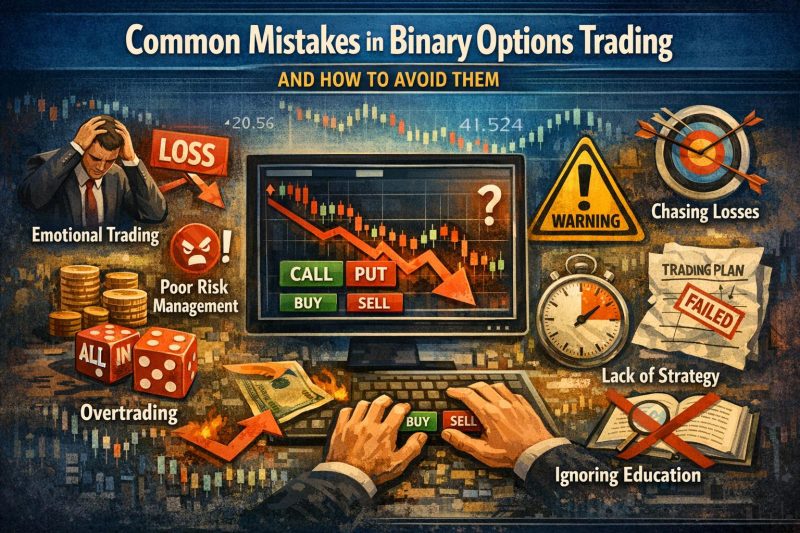
Understanding Binary Options Trading
Binary options trading is a financial method based on a straightforward premise: a trader predicts whether the price of an underlying asset will rise or fall within a specified time frame. If the prediction is correct, the trader receives a predetermined payout. If it is incorrect, the trader loses the invested amount. The simplicity of this structure has contributed to the popularity of binary options across global markets.
Despite this apparent simplicity, binary options trading involves complex market forces, technical considerations, and psychological elements. Many new participants assume that the limited range of outcomes makes it easier than traditional trading, yet the fixed-return structure requires disciplined analysis and structured decision-making. A lack of preparation or unrealistic assumptions can quickly lead to losses.
Binary options can be based on various assets, including currencies, commodities, stocks, and indices. The trader does not purchase the underlying asset but instead speculates on price direction. Time frames can range from seconds to hours or even longer durations. Because outcomes are determined at expiration, timing plays a critical role. Precision in entry and clarity in analysis are essential components of consistent performance.
Understanding the mechanics, risks, and cognitive challenges associated with this trading form is essential before allocating capital. Many common mistakes are avoidable when traders adopt a structured approach grounded in research, risk management, and education.
The Mechanics Behind Binary Options
Binary options differ significantly from traditional asset trading. In traditional markets, profit or loss generally depends on how far the asset price moves. In binary options, however, the payout is fixed, and the trader only needs the asset to be above or below a target level at expiration.
This fixed structure changes the risk-reward profile. A trader may risk 100 units to receive 70 to 90 units in profit if correct. The asymmetry between potential gain and potential loss means that maintaining a favorable win rate is crucial. A series of small incorrect trades can offset several correct predictions if not managed carefully.
Time sensitivity adds another layer of complexity. Short-term options require rapid analysis and quick execution. Longer-term options demand broader market analysis and awareness of economic events that may affect pricing over extended periods.
A clear understanding of how expiration times, strike prices, and payout percentages interact is necessary before placing trades. Confusion about these mechanics often contributes to preventable losses.
Overlooking Proper Research
One of the most significant errors in binary options trading is insufficient research. The perception that trades rely solely on price direction may create the impression that deep market knowledge is unnecessary. In reality, price fluctuations reflect economic indicators, corporate performance, geopolitical developments, and technical market structures.
Effective research involves examining both fundamental analysis and technical analysis. Fundamental analysis considers macroeconomic data such as interest rates, employment figures, inflation rates, and corporate earnings. These variables influence asset valuation and market sentiment over different time frames.
Technical analysis examines chart patterns, historical price behavior, indicators, and statistical tools that attempt to identify trends and reversal points. Traders frequently rely on moving averages, support and resistance levels, volatility measures, and momentum indicators to guide their decisions.
Without adequate research, trades become speculative rather than analytical. Careful observation of price history and awareness of scheduled economic announcements can improve decision quality. Understanding correlations between assets can also provide context; for example, currency pairs may respond significantly to central bank policies, while commodities can be affected by supply data and geopolitical issues.
Thorough research requires consistency. Sporadic analysis or incomplete data may lead to flawed conclusions. Maintaining a structured approach to pre-trade evaluation often improves overall decision-making quality.
Ignoring Risk Management
Risk management is central to long-term sustainability in binary options trading. Because each trade involves a fixed risk, traders must determine how much of their total capital to allocate per position. A common guideline is to risk only a small percentage of total capital on any single trade.
When traders allocate too much capital to one position, a small series of incorrect trades can significantly reduce available funds. This reduction affects the ability to recover losses because future gains are calculated from a smaller capital base.
Effective risk management extends beyond controlling trade size. It includes assessing market conditions before participating. Volatile environments may increase unpredictability, while periods of low liquidity can produce erratic price movements. Recognizing when conditions are unfavorable and refraining from trading is part of disciplined risk management.
Another important aspect involves capital preservation. Traders should differentiate between investment funds and essential living expenses. Using only capital designated for trading activities reduces the risk of financial strain and encourages objective decision-making.
Maintaining accurate records of trades also supports risk assessment. By reviewing historical performance data, traders can identify patterns in successful and unsuccessful decisions, allowing adjustments that refine their strategies over time.
Position Sizing and Capital Allocation
Position sizing is a quantitative method for controlling exposure. Fixed-percentage allocation, where a trader risks a consistent fraction of total capital on each trade, provides structured control. As account size changes, position size adjusts proportionally, preserving stability during both growth and decline phases.
Capital allocation decisions should reflect a trader’s risk tolerance, strategy type, and historical performance. More conservative approaches may allocate smaller percentages, prioritizing capital preservation.
Discipline in adhering to pre-determined limits is essential. Adjusting allocation impulsively after a series of wins or losses can lead to volatility in account balance and undermine long-term planning.
Emotional Trading
Psychological influences often affect trading performance. Although binary options appear mechanical, human judgment plays a central role in selecting trades. Emotions such as overconfidence, anxiety, or frustration may interfere with rational analysis.
For example, after a series of successful trades, a trader may increase position size without adjusting analysis standards. Conversely, after losses, a trader may attempt to recover quickly by entering trades without sufficient evaluation. Both scenarios reflect shifts from structured strategy to emotionally influenced decision-making.
Developing a written trading plan can reduce emotional interference. A trading plan typically defines entry criteria, acceptable risk levels, time frames, and performance objectives. Adhering to predetermined rules limits impulsive deviations.
Maintaining a trading journal provides further clarity. Recording the reasoning behind each trade, as well as the outcome, allows for later review. Over time, patterns may emerge that reveal recurring psychological triggers. Recognizing these patterns supports improved self-regulation.
Consistency in routine also helps stabilize emotional responses. Structured analysis periods, limited trading sessions, and regular performance reviews encourage objectivity and reduce reactive behavior.
Cognitive Biases in Trading
Several cognitive biases can influence trading decisions. Confirmation bias may lead traders to focus only on information supporting their initial view while ignoring contradictory data. Recency bias can cause overemphasis on recent outcomes rather than long-term patterns.
Understanding these biases does not eliminate them, but awareness enables traders to implement corrective measures. Systematic analysis and predefined trade criteria serve as safeguards against cognitive distortions.
Over-Trading
The fast-paced nature of binary options, particularly with short expiration times, can create an environment in which frequent participation appears advantageous. However, excessive trading increases transaction frequency without necessarily improving analytical quality.
Each trade involves risk exposure. When trades are entered without strong justification, the probability of loss accumulates. Focusing on quantity rather than quality can erode capital.
Over-trading often results from misinterpreting short-term market fluctuations as actionable opportunities. Not every price movement represents a favorable setup. Patience in waiting for conditions that align with established criteria improves efficiency and reduces unnecessary risk.
Establishing limits on the number of daily trades or restricting trading to specific market sessions may help maintain discipline. Monitoring performance metrics such as win rate and average return per trade provides insight into whether increased frequency correlates with improved outcomes.
Lack of Education and Training
Entering the market without sufficient preparation is a significant obstacle to long-term participation. Binary options platforms may appear accessible, but operational knowledge is only one component of competency. Understanding order execution, expiration structures, and payout calculation is fundamental.
Educational development should include study of financial markets, economic theory, and statistical principles relevant to price behavior. Many traders benefit from practicing in simulated environments before using real capital. Demo accounts allow familiarity with platform features while testing strategies under actual market conditions without financial risk.
Structured education programs, whether online or in formal academic settings, can strengthen foundational knowledge. Ongoing learning is equally important. Financial markets evolve in response to technological advances, regulatory changes, and shifting macroeconomic conditions. Continuous skill development ensures adaptability.
Strategy Development and Testing
A trading strategy defines specific conditions for entering and exiting trades. Effective strategies are typically based on measurable criteria, such as technical indicators, chart patterns, or macroeconomic correlations.
Before committing capital, strategies should be tested using historical data or simulated trading. Back-testing evaluates how a strategy would have performed under past market conditions. Although past performance does not guarantee future results, testing provides insight into potential strengths and weaknesses.
Refining parameters according to observed outcomes promotes systematic improvement. Random experimentation without documented evaluation often leads to inconsistent performance.
Regulatory Awareness and Broker Selection
Binary options trading environments vary across jurisdictions. Regulatory oversight influences transparency, fund security, and operational standards. Traders should understand the regulatory framework applicable to their region and confirm that any trading platform operates within legal boundaries.
Broker selection affects execution quality, payout reliability, and access to customer support. Evaluating platform stability, clarity of terms, and withdrawal procedures contributes to reducing operational risk.
Due diligence in selecting a trading environment complements strategic discipline. Without it, even well-designed trading plans may encounter practical obstacles.
Market Conditions and Adaptability
Financial markets transition between trending, ranging, and volatile phases. A strategy suited to trending markets may perform poorly in sideways conditions. Recognizing shifts in volatility and liquidity enables traders to adjust or suspend activity accordingly.
Adaptability does not require constant strategy replacement. Rather, it involves identifying which predefined strategies are appropriate under specific conditions. Maintaining awareness of macroeconomic calendars and global events supports informed participation.
Periodic performance evaluation ensures that current methods remain aligned with prevailing market structures.
Conclusion
Binary options trading offers a structured and accessible method of participating in financial markets. Its appeal lies in clear outcomes and defined risk, yet these features do not eliminate complexity. Sustained participation requires detailed research, disciplined risk management, controlled psychological responses, and continuous education.
Common mistakes such as inadequate preparation, excessive risk exposure, impulsive decision-making, and over-trading often stem from misunderstanding the demands of consistent market engagement. By implementing structured analysis, measured capital allocation, informed broker selection, and ongoing evaluation of performance, traders improve their ability to navigate this environment responsibly.
A methodical and informed approach does not guarantee profit, but it enhances consistency and reduces preventable errors. Binary options trading, when treated as a structured financial activity rather than a simplified speculation method, demands planning, evaluation, and disciplined execution.
This article was last updated on: April 5, 2026