
Most writing about binary options targets short term traders who want fast action. It rarely asks a quieter question that matters more if you already invest in stocks, bonds or funds. Do binary options have any sensible role at all for an investor.
Binary options sit at the edge between trading and gambling. The contract is simple. You risk a fixed amount on a yes or no outcome at a set time. If the event happens, you receive a fixed payout. If it does not, you lose the stake. The underlying can be a currency pair, index level, stock price, commodity or almost any market quote.
From an investor’s point of view that simplicity hides several awkward facts. The payoff is all or nothing. The odds are usually tilted against the client by design. The industry has a long record of abusive behaviour and regulatory sanctions. Even where offerings are clean and authorised, the product is built for short horizon bets rather than long term compounding.
This does not mean you must never touch a binary option. It does mean that if you already think in terms of portfolio construction, risk budgets and investment goals, you should see binaries for what they are. A marginal speculative tool with a narrow set of uses, not a substitute for equities, funds, or standard derivatives that allow flexible risk control.
The rest of this piece stays in that register. It explains how binaries work, why the odds usually favour the issuer, where the main risks sit, and where an investor might reasonably stop and say no.
We recommend that investors who are looking for more suitable investments visit Investing.co.uk. They feature information on financial instruments that are more suitable for investments than binary options.
Contents
What a binary option actually is, contract by contract
A binary option is a contract linked to some underlying reference such as a market index, currency, commodity or stock. It has a strike level, an expiry time and a fixed payout rule.
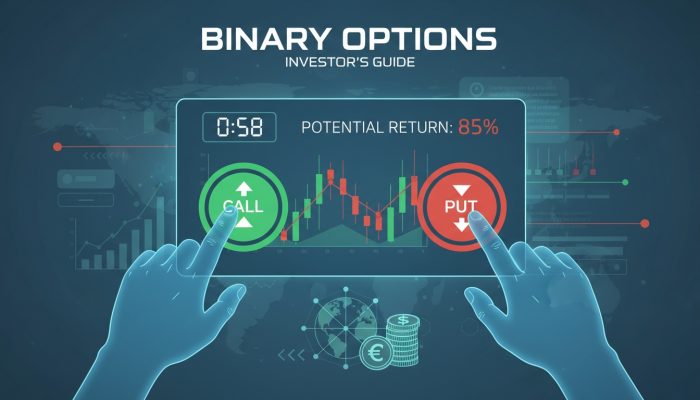
The usual format for retail users looks like this. You choose an underlying market, for example EURUSD or an equity index. You choose a direction, often labelled “higher” or “lower”. You choose an expiry, maybe five minutes, one hour or the end of the trading day. The platform shows you a potential payout. You stake a sum. When expiry arrives, the platform checks a reference price. If it meets the condition, you receive the stated payout. If it does not, your stake is gone.
The contract does not care about the path. Price can swing up and down during the life of the option. It can be in profit for most of the period then reverse in the final seconds. Only the settlement price at expiry matters. That is different from a normal option or a share position, where your profit or loss changes tick by tick and you can lock a result at any point by closing the position.
Institutional binary options, often called digital options, use a similar structure at a more technical level. A digital call pays a fixed amount if the underlying is above a strike at expiry, zero if not. A digital put pays when the underlying is below the strike. Prices for these contracts on banks’ books are set by option models that map implied volatility and time to expiry into probabilities of finishing in the money.
Retail versions are simpler on the surface but follow the same concept. The platform does not show you the model, just a clear stake and payout. That is exactly what makes them easy to market. The fixed loss per contract feels safe. The one button choice feels tame. The complexity and edge sit behind the interface, in how payouts relate to actual probabilities.
Pricing, odds and why the house usually builds in an edge
For an investor, the crucial question is not how colourful the platform looks but how the odds work. Binary options are one of the few financial contracts where you can state the edge in casino style terms.
Take a simple contract with a fifty fifty chance of ending in the money. In a fair game, if you risk 100, you would receive 200 back on a win. Your net gain would be 100, your loss on a miss would be 100, and the expected value over many plays would be zero before any external costs.
Retail binary interfaces do not usually offer that. A common structure is risk 100 to receive 180 back if you are right. Your net gain on a win is 80, while your loss on a loss is the full 100. If the true probability really is fifty percent for each outcome, the expected result over a large sample of bets is negative. On average per trade you lose ten units of account. The difference between 200 and 180 in the win case is effectively the house edge.
Day traders sometimes try to beat this with high hit rates. Suppose you manage to be right sixty percent of the time on trades with the same 180 payout. Your expected value per trade becomes 0.6 times 80 minus 0.4 times 100, which is roughly eight units in your favour. That looks promising, but you would need to maintain that edge consistently, across changing volatility and news conditions, while avoiding behaviour mistakes like chasing losses or over staking.
In practice most clients do not reach that level. Hit rates hover closer to random, especially on very short expiries where noise dominates. The platform designers know this. Payout tables are tuned so that across large volumes of trades, average client balances trend down in a reasonably predictable fashion, just as a casino expects from games with known edges.
Another detail is that the odds are not static. Payout ratios can vary with time of day, underlying volatility and contract structure. Range binaries and “touch” contracts often carry different edges than simple up or down ones. Without access to the pricing engine, a retail investor cannot easily tell which parts of the menu are more expensive in expectation.
For investors used to thinking about expected returns on asset classes, this is the core problem. Binaries are not like equities or bonds, where the long term expected return is positive because you are sharing in cashflows and growth. They look more like fair bets that have had a margin shaved off each outcome, so the long term expected return is negative unless you have a genuine forecasting advantage and unusual discipline.
Regulatory history and fraud patterns around binaries
Beyond pure odds, binary options carry another layer that matters to investors who care about governance and legal risk. The business has a long record of misconduct.
Over the last decade, regulators in many regions have issued repeated warnings about binary offerings. Common patterns in complaints include misleading marketing claims, refusal to process withdrawals, unauthorised bonus schemes that lock client funds until very high turnover thresholds are met, and manipulation of price feeds near expiry to mark contracts as losses.
This prompted a wave of bans and restrictions. Some territories prohibited the marketing or sale of binaries to retail clients entirely. Others imposed tougher conduct rules, forcing brokers to show risk warnings, publish data on client loss rates, and clean up advertising that portrayed binaries as simple income tools. In certain cases regulators have taken civil and criminal action against operators that ran outright scams.
As a result, the retail binary space looks patchy. There are a few regulated venues, sometimes structured as exchanges with order books and transparent pricing for contracts that pay 0 to 100. There are also offshore sites registered in lenient jurisdictions that still target clients around the globe, often through online ads and affiliate marketing, with thin or no local oversight.
For an investor the takeaway is not just “some operators are untrustworthy”, although that is true. It is that binary options, as a category, now trigger a higher level of suspicion among watchdogs. That can affect which products are allowed in retirement accounts, how banks treat transfers to and from certain brokers, and whether you have meaningful recourse when things go wrong.
If your usual portfolio lives in regulated stock, bond and fund markets, moving a portion into a segment known for blurred lines between trading and gambling, and with a history of abusive practice, changes the risk character of your holdings in ways that go beyond price volatility. You are taking on legal and counterparty risk that is very different from what you see in mainstream listed markets.
How binary options differ from normal options and linear products
Binary options are sometimes sold with phrases like “simple options” or “options without complexity”. That is a bit misleading. They are different contracts, not stripped down versions of listed calls and puts.
In a standard call option on a stock, your payoff at expiry rises linearly once the stock trades above the strike. The further it rallies, the more you earn, minus the premium you paid. You have the right, not the obligation, to buy the stock at the strike. You can also close the option before expiry by selling it back into a market that reflects current time value and implied volatility.
A binary call, by contrast, pays a fixed amount if the stock is above the strike at expiry, zero if not. There is no extra profit beyond the fixed level if the stock flies far beyond the strike. There is often no natural secondary market where other traders quote prices; in many cases the broker itself is the only party quoting an early exit price, which it sets to its own advantage.
Linear instruments such as shares, futures or contracts for difference move tick by tick. If an index future rises by ten points, your P and L adjusts immediately. You can cut losses early, take partial profits, hedge with other positions, and use a range of stop types. Your final result depends on the path and on your decisions along that path, not just on one print at a fixed time.
In binaries, path flexibility is much weaker. The structure is all or nothing at expiry unless you accept the broker’s early close quote. That destroys many of the usual risk management levers that investors use. You cannot move a stop to break even or scale out gradually. The contract design does not care that you were “right” for most of the period. It only cares where things land at the end.
From an investor viewpoint another difference is that standard options and linear products connect directly to real economic exposures. A company uses currency and commodity options to hedge cashflows. Asset managers use index futures to adjust portfolio exposure ahead of large flows. Binaries are much harder to fit into such use cases. Their payoff is neat for pure speculation, far less suited to nuanced hedging or long term asset allocation.
That does not make binaries illegitimate as financial contracts. It does mean that they belong in a separate mental bucket from the derivatives and assets that investors normally use to match portfolios to goals.
Portfolio role: can binaries have any place in an investor toolkit
Given how they behave, the more honest question for an investor is not “how do I add binaries to my strategy” but “is there any narrow role for them at all”.
They are not suitable as a core holding. There is no income stream, no link to long term growth or corporate value, and a negative expected return if you trade without edge. That rules them out as building blocks for retirement investing, standard long only equity allocation, or bond like functions.
They also sit awkwardly as hedges. The all or nothing structure can, at best, insure against very specific short term events. For example, a binary that pays if an index closes below a certain level on a central bank decision date could, in theory, offset some loss on your holdings if markets drop sharply on that day. In practice, it is hard to size and time such hedges well, and they do not protect against slower, drawn out moves that matter more for longer term investors.
Where binaries might have a marginal role is as a capped risk speculative sleeve, if you deliberately cordon off a small amount of capital for very short horizon ideas. You might, for instance, decide that a small percentage of your liquid assets is available for high convexity bets around data releases or event dates, with the understanding that loss of this sleeve does not affect your main financial plans.
Even in that role, you still need to justify why binaries beat more standard tools. There are other ways to take event risk, such as short dated vanilla options, small futures positions with hard stops, or event driven trades in equities. Those methods usually give more flexibility and a clearer link to underlying markets without the same built in house edge.
For most investors with a basic but solid understanding of markets, the sober answer is that binaries are, at best, optional speculative toppings. They do not help you generate long term compounding, they do not align well with the time horizons of saving and retirement, and they do not deliver anything on the hedging side that cannot be handled, often better, with more familiar instruments.
Behaviour and psychology: why investors struggle with all or nothing bets
Beyond maths and regulation, binary options tap into a set of behavioural biases that can do serious damage when investors treat them as more than entertainment.
The short time frame from trade to result encourages impulsive behaviour. You place a bet for five or fifteen minutes, watch a countdown, then see a complete win or loss. There is no half credit for being nearly right. The urge to “try again” after a near miss is strong, especially when each stake feels small compared with total net worth.
Because the loss on any single contract is capped, there is a temptation to see each bet as harmless. This hides the fact that loss adds up across many trades. Ten one percent bets that all fail in a choppy day still remove a tenth of the capital allocated. Raise stake size emotionally in the middle of that run and losses escalate even faster.
Investors used to slower moving products can also underestimate how quickly binary trading can displace their normal process. A session that starts with a plan to take one or two small event driven positions can turn into dozens of rapid bets as boredom or frustration creep in. The behaviour starts to look less like investing and more like time at a roulette wheel, only with charts.
Another bias is anchoring on recent results. A good streak of wins in binaries can feel like proof that you have unlocked a pattern in short term price moves. That can lead to larger stakes and relaxed filters, even if the underlying hit rate is little more than random. Because outcomes are all or nothing, a later losing streak gives back gains in very visible chunks, which often triggers tilt and more chasing.
Investors who normally think carefully in terms of risk budgets, drawdowns and objectives can find themselves defending binary activity with lines like “it is only a small part of the portfolio” while still realising that the amount of attention and emotion it consumes is far larger than the capital slice would justify.
One way to test whether binaries have become a problem is simple. Ask yourself how often you think about them or log into the platform compared with more boring, long term positions. If a tiny allocation is taking up most of your mental energy because of the fast feedback and drama, the product is probably not helping your investment discipline, even if the monetary stakes are modest.
Alternatives that deliver similar payoffs with more structure
If you strip away the marketing, many investors reach for binaries because they want three things. Defined risk per trade, exposure to short term events, and a sense of convex payoff where a small stake can lead to a larger gain.
The capital markets already offer tools that meet those needs without some of the worst binary quirks.
Short dated vanilla options around events can limit downside to the premium paid while leaving upside open beyond a strike. A call bought ahead of a company’s earnings report or a macro release costs a known amount and can be sized in line with portfolio risk rules. If the event goes your way, gain scales with the move. If not, loss is capped. Pricing is more transparent, with active markets on many exchanges and clear model inputs.
Small futures or CFD positions with hard stops provide another route. You can define a monetary loss level and exit if price passes predefined levels, while still having the ability to adjust, scale or hedge during the trade. There is no built in house edge in the same way as most binary payout ratios; your edge or lack of it comes more from your decisions and costs like spread and commission.
Structured products such as barrier options and digital options exist on major exchanges and OTC desks in more transparent form, with quotes from multiple dealers. For investors working with advisers, these can replicate some binary style payoffs while being documented clearly and embedded in regulated frameworks.
Even plain long or short exposure, used around clear event windows with strict limits on size and timing, can satisfy the urge to take a view without the particular behavioural pull of ticking timers and simple win or lose messages.
None of these tools are risk free. They still require education, discipline and sensible sizing. But they align better with normal investment language. They allow finer control over exit points, interaction with other holdings, and integration into broader portfolio risk thinking.
Treating binaries as speculation, not core investment
For investors with basic knowledge and a genuine concern for long term outcomes, binary options should sit in a very small, clearly labelled corner of the mental map, if they appear on the map at all.
They are simple contracts with fixed payoffs, usually priced so that the expected return for an average user is negative. They sit in a part of the market where misconduct has been common and regulation reactive. They compress risk into short, all or nothing bets that feed directly into bias and impulse. And they do not link to the slow, compounding cashflows that underpin most wealth building assets.
None of that makes them forbidden. People buy lottery tickets and go to casinos while still running sensible investment plans. The trouble starts when a product that behaves like a structured bet is rebranded, in your head or in marketing, as an investment strategy.
If you decide to trade binaries anyway, the most honest framing is to call them speculation. Money placed there is money you can live without. Time allocated there is time taken away from analysing assets that can actually carry your financial goals. For most investors that simple mental distinction helps keep the rest of the portfolio on a saner path, and keeps a neat little contract from quietly hijacking both returns and attention.
This article was last updated on: February 17, 2026