
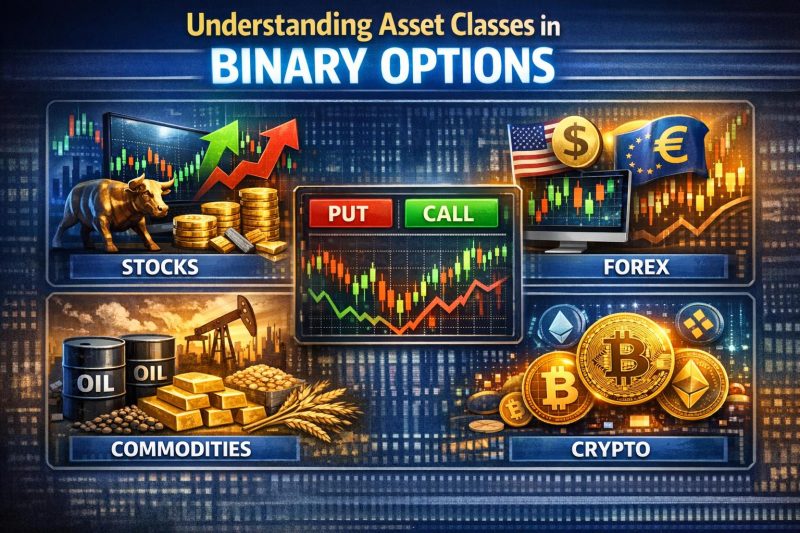
Understanding Asset Classes in Binary Options
Binary options trading is structured around a straightforward premise: a trader predicts whether the price of a selected asset will move above or below a specified level within a defined time frame. While the mechanism appears simple, the underlying asset classes introduce layers of complexity that shape price behavior, volatility, liquidity, and risk exposure. A thorough understanding of these asset classes is essential for developing informed trading strategies and managing risk effectively.
Binary options are derivatives, meaning their value is derived from the performance of an underlying asset. Rather than acquiring ownership of the asset itself, traders enter into a contract that yields a fixed payout if their prediction proves correct, or a defined loss if it does not. Because the payout structure is predetermined, the characteristics of each asset class play a central role in shaping probability assessments and potential outcomes.
The primary asset classes available in binary options trading typically include stocks, foreign exchange (forex), commodities, and cryptocurrencies. Each demonstrates distinct patterns of price movement, regulatory influences, liquidity conditions, and sensitivity to macroeconomic factors.
Stocks
Stocks represent equity ownership in publicly traded companies. When trading binary options on stocks, the trader does not purchase shares. Instead, the trader forecasts whether the stock price will rise or fall relative to a strike price at expiration. The outcome depends entirely on the stock’s market price at the predefined expiry time.
Stock prices are shaped by corporate performance, earnings announcements, sector developments, and broader economic conditions. Quarterly earnings reports often generate short-term volatility, which can be relevant for short-duration binary options contracts. For example, if a company releases better-than-expected earnings, the stock price may shift significantly within minutes or hours, influencing binary options outcomes tied to that event.
In addition to earnings data, factors such as revenue growth, profit margins, debt levels, management decisions, mergers, regulatory changes, and product launches contribute to valuation. Broader market indices may also affect individual stock prices, particularly when macroeconomic developments alter investor sentiment across sectors.
Liquidity varies depending on the company’s size and trading volume. Large-cap stocks typically demonstrate narrower price spreads and more consistent trading activity, while smaller-cap stocks may exhibit wider fluctuations. Traders assessing binary options tied to stocks often consider both historical volatility and scheduled news releases, as these can materially influence short-term price direction.
Market sentiment also plays a role. Even when fundamentals remain stable, shifts in investor outlook can lead to price adjustments. In the context of binary options, the limited timeframe underscores the importance of timing and awareness of scheduled corporate disclosures.
Forex
The foreign exchange market is one of the largest and most liquid financial markets globally. Forex trading involves currency pairs, where the value of one currency is measured relative to another. In binary options trading, participants predict whether a currency pair such as EUR/USD or USD/JPY will rise or fall by expiration.
Currency values are influenced by macroeconomic conditions, interest rates, monetary policy decisions, inflation data, employment statistics, trade balances, and geopolitical developments. Central bank communications can significantly impact forex markets, particularly when they hint at future changes in interest rates or liquidity measures.
Interest rate differentials between two countries are especially relevant. When one country offers higher interest rates relative to another, its currency may attract investment flows, strengthening its value. Binary options traders may analyze central bank policy statements and economic calendars to anticipate potential movements during scheduled announcements.
Forex markets operate continuously during the business week, providing extended trading opportunities. The high liquidity of major currency pairs often leads to relatively tight spreads and active price movements. However, volatility can increase during economic releases or unexpected geopolitical events.
Time horizon plays a significant role in forex-based binary options. Short-duration trades may focus on technical analysis, including chart patterns and momentum indicators. Longer durations might emphasize macroeconomic expectations and monetary policy trends. Because the binary payout is fixed, understanding typical currency pair volatility can help traders assess whether expected price movement is sufficient to cross the strike threshold.
Commodities
Commodities include physical goods such as precious metals, energy resources, and agricultural products. In binary options trading, participants speculate on the price direction of commodities like gold, silver, crude oil, or wheat within a specified timeframe.
Commodity prices are influenced by supply and demand conditions. For example, crude oil prices are affected by production decisions from major producing countries, inventory data, refinery activity, and global energy consumption patterns. Gold often responds to macroeconomic uncertainty, currency fluctuations, and interest rate expectations.
Agricultural commodities are sensitive to weather patterns, seasonal cycles, crop yields, and transportation logistics. Droughts, floods, or adverse growing conditions may restrict supply, leading to price increases. Conversely, surplus production can exert downward pressure.
Geopolitical developments may also influence commodity markets. Political instability in regions critical to oil production, for instance, may lead to supply disruptions and price volatility. Trade policies and tariffs can further affect global commodity flows.
In binary options trading, price sensitivity to news events can create both opportunities and risks. Because commodities may experience sharp price adjustments following inventory reports or geopolitical events, traders often monitor economic calendars and industry-specific reports. For instance, weekly energy inventory data releases are closely watched in oil markets.
Volatility profiles differ across commodities. Precious metals may move in response to changes in interest rates or inflation expectations, while agricultural products demonstrate more pronounced seasonal cycles. Understanding these behavioral patterns allows traders to better estimate the probability of a price crossing a predetermined level before expiration.
Cryptocurrencies
Cryptocurrencies represent a newer asset class in financial markets. Digital assets such as Bitcoin and Ethereum operate on decentralized blockchain networks and are traded on specialized exchanges. In the context of binary options, traders predict whether the cryptocurrency’s price will move above or below a set point within a defined time period.
Cryptocurrency markets are generally characterized by higher volatility compared to traditional asset classes. Price movements can be influenced by technological developments, regulatory announcements, market adoption trends, institutional participation, and broader investor sentiment.
Regulatory developments are particularly impactful. Announcements regarding cryptocurrency legality, taxation, exchange oversight, or institutional integration may trigger substantial price movements. Similarly, updates to blockchain protocols or shifts in network usage can alter investor perception and price direction.
Unlike traditional markets that operate within set hours, cryptocurrency markets function continuously. This constant availability can lead to price changes outside typical financial market hours, creating ongoing exposure for binary options tied to these assets.
Liquidity varies across different cryptocurrencies. Major digital currencies typically exhibit higher trading volumes, while smaller tokens may experience wider price movements and lower liquidity. For binary options traders, volatility levels influence the likelihood of significant price shifts within a short expiration window.
Market sentiment often drives cryptocurrency price action. Social media discussions, technological innovations, and public endorsements can create momentum, independent of traditional valuation metrics. As a result, traders may incorporate sentiment indicators and technical analysis when evaluating binary options in this asset class.
Comparative Characteristics of Asset Classes
Although the binary options structure remains consistent, differences between asset classes affect trading strategies and risk assessments. Stocks may respond prominently to company-specific developments, while forex pairs are driven largely by macroeconomic forces and interest rate differentials. Commodities often reflect physical supply constraints and global consumption trends, whereas cryptocurrencies respond strongly to technological progress and regulatory frameworks.
Volatility levels vary considerably. Cryptocurrencies and certain commodities can demonstrate sharp intraday price shifts, while major forex pairs may exhibit comparatively measured changes under stable conditions. Liquidity also differs, influencing price stability and execution reliability.
Correlation between assets is another consideration. For instance, gold may move inversely to certain currencies during periods of economic uncertainty. Understanding cross-asset relationships can inform risk management decisions when multiple binary options positions are held simultaneously.
Risk Considerations Across Asset Classes
Binary options inherently involve defined risk and reward parameters, but the probability of achieving a favorable outcome depends on accurate market assessment. Each asset class carries distinct risk factors.
Stock-based binary options may be affected by sudden corporate disclosures or unexpected earnings results. Forex contracts can experience volatility during economic releases. Commodity prices may shift due to unforeseen geopolitical or environmental events. Cryptocurrencies may react to regulatory announcements or technological issues without prior notice.
Expiration timeframes further shape risk exposure. Very short-term contracts may be highly sensitive to transient price fluctuations, while longer durations expose traders to broader market developments. Selecting an asset class with appropriate volatility characteristics relative to the chosen timeframe is a key strategic decision.
Market accessibility and regulatory oversight vary by jurisdiction. Traders should ensure they are operating within applicable regulatory frameworks and understand platform-specific terms before entering into contracts.
Role of Analysis Methods
Regardless of asset class, analytical approaches can generally be divided into fundamental analysis and technical analysis. Fundamental analysis examines economic and financial factors influencing intrinsic value, such as earnings performance, macroeconomic data, or supply-demand conditions. Technical analysis focuses on historical price patterns, trend indicators, support and resistance levels, and momentum measurements.
Certain asset classes may lend themselves more naturally to one approach over another, depending on timeframe and volatility. Forex traders often monitor economic indicators closely, while cryptocurrency traders may emphasize technical signals due to rapid sentiment shifts. Commodity participants frequently consider both macroeconomic data and seasonal patterns.
A comprehensive understanding of analysis techniques strengthens the ability to evaluate probable price direction within the binary option’s expiration window.
Conclusion
Binary options trading spans multiple asset classes, each governed by distinct market forces and structural characteristics. Stocks reflect corporate and sector performance, forex captures macroeconomic and currency dynamics, commodities respond to supply-demand conditions and geopolitical developments, and cryptocurrencies introduce technology-driven volatility and continuous trading conditions.
While the trading mechanism is uniform across these categories, informed decision-making requires familiarity with the underlying asset’s behavior, risk profile, volatility patterns, and external influences. By analyzing economic indicators, corporate disclosures, regulatory developments, and market sentiment, traders can form reasoned assessments aligned with their strategies and risk tolerance.
Understanding the nuances of each asset class contributes to clearer probability evaluation, improved timing considerations, and a more structured approach to binary options participation.
This article was last updated on: March 5, 2026